When runners deal with a recurring niggle, pain, or performance plateau, “get your gait checked” is common advice.
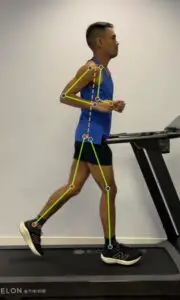
A running gait analysis can show details you may not feel while you’re running. Video footage may reveal a hip drop, a lower cadence, a long stride, a particular foot strike pattern, or changes in form when you speed up, or fatigue.
That information can be helpful for sure, it just needs context.
Running form footage shows what’s happening when you run. But it doesn’t automatically explain why it’s happening, whether it’s relevant to your symptoms, or what should change next.
A useful running gait analysis should also consider your strength, mobility, training history, shoes, symptoms, goals, and how your body responds to load. Without that context, video can become a guessing game.
What Running Video Analysis Can Show
Video footage can help identify movement patterns that may be relevant to performance, comfort, or injury risk.
For example, it may show cadence, stride length, foot strike pattern, trunk position, pelvis and hip control, knee position, arm swing, side-to-side differences, and how your form changes with speed or fatigue.
These details can be helpful when they’re matched to your symptoms and training goals. Research supports the use of video-based running biomechanics assessment as a practical clinical tool when it’s used in a structured way. Video can help assess common running mechanics such as cadence, foot strike, overstriding, hip motion, and trunk position.
Where runners can get into trouble is assuming that every video finding needs to be corrected. A running assessment should help separate useful findings from normal variation.
Why Video Footage Needs Context
Two runners can look similar on video but need very different plans.
One runner might show a visible hip drop because they lack hip strength or single-leg control. Another might show the same pattern because they’re running too fast for their current capacity, recovering from a recent injury, or wearing shoes that change how they interact with the ground.
The movement can look similar, while the solution is completely different.
That’s why I’m cautious about turning every video finding into a correction. A mild asymmetry may be normal for that runner. A heel strike may be totally fine. A lower cadence may only be relevant if it connects to symptoms, overstriding, braking, or training goals.
Pain and performance are influenced by more than what a runner looks like in one short clip.
Running gait analysis is most useful when it helps answer better questions, rather than giving runners a long list of things to worry about.
“Bad Form” Is Not Always the Reason Something Hurts
Runners are often quick to blame their form, and that’s understandable; how many times have you heard the phrase “heel striking is bad” thrown around?
IKnee pain can make it easy to assume you must run “wrong.” An ache in your hip may have you wondering whether your gait is the problem. If a friend points out that you heel strike, you might start worrying that your entire running style needs an overhaul.
But running mechanics aren’t neatly divided into “good” and “bad.”
Plenty of runners heel strike without pain. Others forefoot strike and still get injured. Some asymmetries are normal. A runner may look a little uneven on video and still tolerate training well.
There’s no point fixing what isn’t broken. If a foot strike or asymmetry isn’t linked to pain, performance issues, or repeated overload, changing it may add unnecessary complexity without improving the outcome. And in some situations, changing one’s foot strike can cause new problems elsewhere.
Biomechanics can influence how load is distributed through the body. Injury risk usually depends on whether the tissues receiving that load are prepared to tolerate it.
That’s why form changes should have a clear reason. If something in your form is working well for you, and it’s not contributing to symptoms or limiting your running, it may not need to change.
Running Form Is Only One Part of Load
A runner’s body adapts when the stress applied is appropriate for its current capacity. Problems often show up when training stress exceeds what the body can currently handle.
That stress can come from many places.
Your weekly mileage may have increased. Your long run distance may have jumped too quickly. You may have added hills, speed work, trails, strength training, or a new pair of shoes. Maybe you’re also dealing with poor sleep, high work stress, under-fuelling, or a busy family schedule that limits recovery.
Video footage won’t show all of that.
It may show how you move, but it won’t tell us that you added two hill sessions, changed shoes, slept five hours a night, and started doing heavy lunges in the same week.
That context matters because your body counts the total load, not just the run that we see on camera.
Training-related factors, including distance, frequency, duration, and intensity, have been studied in relation to running injuries, which supports the need to look beyond form alone when assessing runners.
Why Strength and Mobility Testing Belong in a Running Assessment
If video shows what happens during running, strength and mobility testing help explain what options your body has available.
If your knee moves inward while running, the assessment should look at whether you can control that position during a step-down, manage load on one leg, access enough ankle mobility, maintain control with fatigue, and whether the pattern is actually linked to your symptoms or goal.
In a running assessment, I include strength and mobility analysis because running is a repeated single-leg activity. Every step requires your body to absorb force, control position, and push off again. If you don’t assess those qualities off the treadmill or away from the camera, you’re missing key pieces of the puzzle.
Strength testing can help identify where capacity may need to improve. Mobility testing can show whether a runner has access to the positions they’re trying to use. Together, those tests help identify which physical qualities are actually worth addressing.
[You can browse running specific strength programs HERE.]
Shoes Can Change the Picture Too
Shoes don’t solve everything, but they can influence how running feels and how your body loads.
A shoe that works fabulously for one runner may feel awful for another. A worn-out shoe may change comfort. A major shift in heel-to-toe drop, stack height, stiffness, or support may change how your calf, foot, knee, or hip handles load.
Every runner does not need to be placed into a specific shoe category; footwear simply belongs in the assessment conversation.
If a runner has knee pain, calf tightness, or foot symptoms; I want to know what they’re wearing, how long they’ve had those shoes, what changed recently, and whether symptoms match a footwear change.
Video might show a particular foot strike pattern. Footwear history helps us understand whether shoes may be part of the broader load picture.
Symptoms Should Guide the Interpretation
A running gait analysis without symptom context can become misleading.
A runner with no pain, good performance, and consistent training may not need major form changes just because something looks slightly uneven. On the other hand, a runner with recurring symptoms may benefit from targeted changes if the video findings match their history, strength profile, and symptom behaviour.
A few questions help guide the interpretation:
- Where is the pain?
- When does it show up?
- What makes it better or worse?
- Did it start after a specific change?
- Does it happen only with hills, speed, long runs, or fatigue?
- Does it settle within 24 hours?
- Has it happened before?
The same video finding can mean different things depending on the answers.
This is also why I would never tell a runner that their form is “bad”, that language is not only inaccurate, but also not helpful.
A better approach is to identify what may be useful to change and what can be left alone.
What Video Analysis Can’t Tell You by Itself
Video analysis can show how you move, but it can’t answer every question.
By itself, video can’t tell you:
- How quickly your training load changed
- How well you’re recovering
- Whether you’re sleeping enough
- Whether you’re eating enough to support your training
- How strong your calves, hips, quads, or trunk are
- Whether your symptoms are improving, worsening, or spreading
- Whether your body is ready for more speed, hills, or mileage
- Whether your current mechanics are actually a problem
That’s why video analysis should be one tool within the assessment. When we combine treadmill analysis with strength, mobility, injury history, footwear, symptoms, and training context, we get a clearer picture of what’s going on. From there, the plan becomes much more valuable.
What a Complete Running Assessment Should Include
A complete running assessment should consider how you run alongside what your body is currently prepared to tolerate.
At Morgan Exercise Physiology, a running assessment includes treadmill running analysis along with a strength and mobility assessment. That means we’re looking at how you move, what your body can tolerate, and what your training has been asking of you.
A complete assessment usually considers your training history, recent changes, injury history, goals, symptoms, shoes, strength, mobility, and running footage.
For example, a runner might book a running gait analysis because their knee hurts during downhill running. The video may show overstriding and a low cadence, which can both contribute to knee pain. The full assessment might also reveal a sudden change in running surface (road vs trail), reduced quad capacity on step-down testing, shoes that are past their useful life, and symptoms that flare after long downhill sections.
For that runner, the next step is a plan that connects the video findings with strength, symptoms, training load, and goals. The plan may include cadence work, downhill load management, quad and hip strengthening, shoe discussion, and a gradual return to hills.
When Running Form Changes Are Helpful
Running form changes can be helpful when they are targeted, manageable, and connected to a clear reason.
A cadence increase may help some runners reduce overstriding. A quieter landing cue may help another runner reduce impact. A shorter stride on downhills may help someone with knee symptoms. A trunk position cue may help a runner who is braking heavily.
Most runners do best with one focused change at a time. The cue should feel natural enough that it doesn’t create tension everywhere else. It should also be tested against symptoms, comfort, pace, and fatigue.
A good cue should feel manageable and should not create tension, discomfort, or a new problem somewhere else.
Running Form Is Individual
One of the biggest lies runners have been told is that there’s one perfect way to run.
There are useful principles, but there’s also a lot of individual variation. Your body, injury history, training background, goals, and tolerance all influence what makes sense for you.
The goal of a running assessment is to help you understand what’s working well, what might be contributing to your symptoms, what your body needs more capacity for, whether form changes are useful, and how to move forward without guessing.
A good assessment also doesn’t have to end with “fix this.” Sometimes the most useful outcome is knowing that no major form change is needed. In that case, your time may be better spent maintaining consistency, building strength, or managing training load.
The recommendation depends on what the assessment actually shows. It may be a running cue, a strength plan, a training adjustment, a race-plan change, or reassurance that your current form is serving you well.
The Bottom Line
Running gait analysis is valuable, but video footage is only one part of the assessment.
It can show how you move. But to make that information useful, we also need to understand your strength, mobility, training load, shoes, recovery, symptoms, and goals.
A useful running assessment looks at the whole runner. Combining video with strength, mobility, symptoms, and training history, makes the findings much more useful for planning what comes next.
Key Takeaways
- A complete running gait analysis should include strength, mobility, training history, shoes, symptoms, and goals.
- Not every visual asymmetry, heel strike, or form pattern needs to be corrected.
- Running form changes work best when they are targeted, manageable, and connected to the runner’s symptoms or goals.
- Strength and mobility testing help explain why a movement pattern may be happening.
- A full running assessment can provide a clearer plan than video footage alone.
Thinking about getting a running gait analysis?
A complete running assessment gives you more than a video of your stride. We’ll look at your running footage, strength, mobility, training history, shoes, symptoms, and goals so you leave with practical next steps, not a random list of things to fix.
Book a running assessment in Port Moody, BC
You can also also subscribe to my newsletter or follow me on Instagram for more evidence based tips for runners
Frequently Asked Questions about Running Gait Analysis
A running gait analysis is an assessment of how you run. It often includes video footage of your running form, but a complete assessment should also consider strength, mobility, training history, shoes, symptoms, and goals.
Video analysis can be helpful, but it is usually not enough on its own. Running injuries are often influenced by training load, strength, mobility, recovery, footwear, previous injury, and symptom behaviour, not just form.
A running gait analysis may help identify movement patterns or training factors that could contribute to symptoms or overload. It works best when combined with strength testing, mobility assessment, and a review of training history.
Not always. Some movement patterns are normal and do not need to be corrected. Form changes should be targeted to your symptoms, goals, and assessment findings rather than based on appearance alone.
Heel striking is not automatically bad. Some runners heel strike without pain or injury. Foot strike only matters if it’s relevant to your symptoms, performance goals, or how load is being distributed through your body.
A complete running assessment should include running footage, strength and mobility testing, symptom review, training history, footwear discussion, and practical recommendations for training, exercise, and form if needed.
You can book a running assessment in Port Moody, BC, at Morgan Exercise Physiology. The assessment includes video analysis along with strength, mobility, training history, footwear, and symptom review.
References
Bertelsen, M. L., Hulme, A., Petersen, J., Brund, R. K., Sørensen, H., Finch, C. F., Parner, E. T., & Nielsen, R. O. (2017). A framework for the etiology of running-related injuries. Scandinavian journal of medicine & science in sports, 27(11), 1170–1180. https://doi.org/10.1111/sms.12883
Doyle, E., Doyle, T. L. A., Bonacci, J., & Fuller, J. T. (2022). The Effectiveness of Gait Retraining on Running Kinematics, Kinetics, Performance, Pain, and Injury in Distance Runners: A Systematic Review With Meta-analysis. The Journal of orthopaedic and sports physical therapy, 52(4), 192–A5. https://doi.org/10.2519/jospt.2022.10585
Fredette, A., Roy, J. S., Perreault, K., Dupuis, F., Napier, C., & Esculier, J. F. (2022). The Association Between Running Injuries and Training Parameters: A Systematic Review. Journal of athletic training, 57(7), 650–671. https://doi.org/10.4085/1062-6050-0195.21
Napier, C., & Willy, R. W. (2021). The Prevention and Treatment of Running Injuries: A State of the Art. International journal of sports physical therapy, 16(4), 968–970. https://doi.org/10.26603/001c.25754Souza R. B. (2016). An Evidence-Based Videotaped Running Biomechanics Analysis. Physical medicine and rehabilitation clinics of North America, 27(1), 217–236. https://doi.org/10.1016/j.pmr.2015.08.006