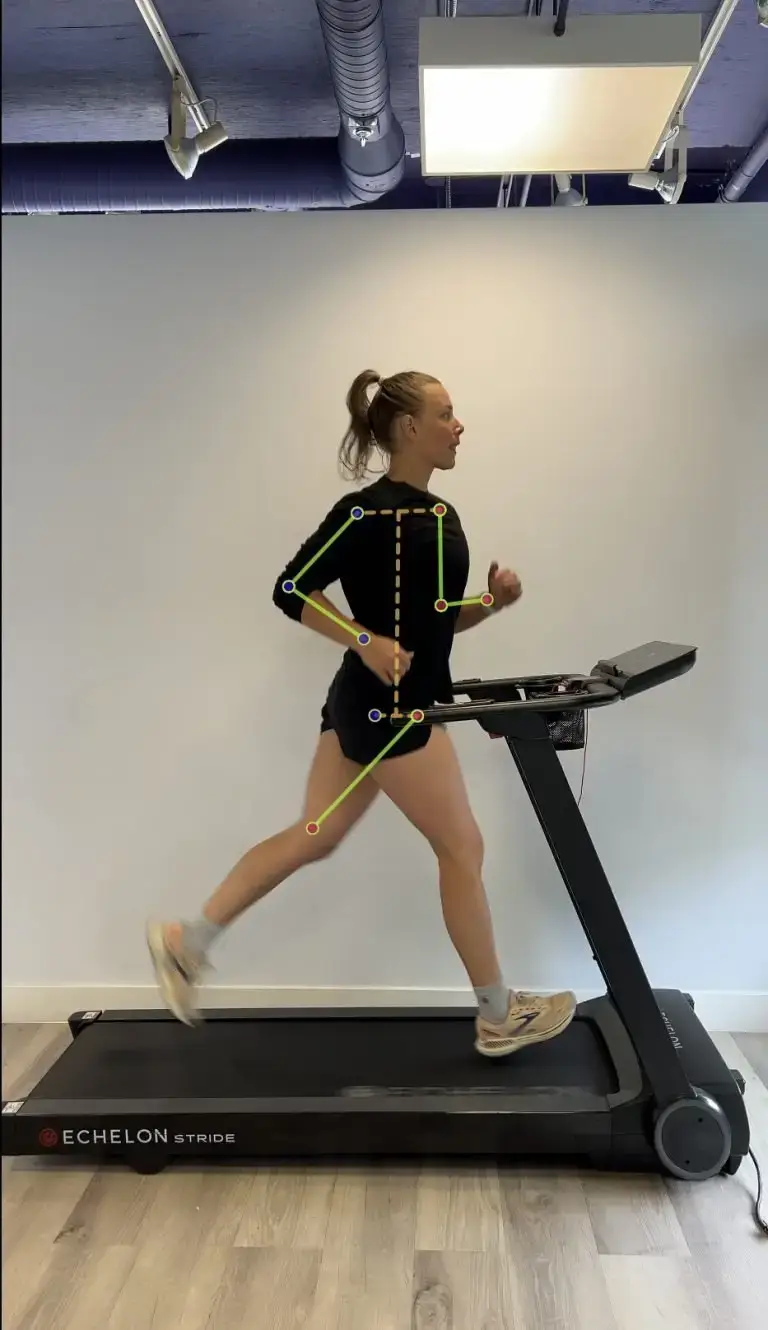
A running assessment helps you understand how you run, what may be contributing to pain or inefficiency, and what to work on next.
For some runners, that means figuring out why the same injury keeps coming back. For others, it means improving running mechanics, building confidence, or getting clearer on what’s actually worth changing.
In this post, you’ll learn:
- What a running assessment is
- What we look at during an assessment
- What you’ll leave with
- Who should book one
- What a running assessment can’t tell you
What Is a Running Assessment?
A running assessment is a structured analysis of your running technique and the factors that influence it.
That includes:
- How your foot lands relative to your centre of mass
- How your lower leg and knee line up at landing and push off
- How your pelvis and trunk control hold up as you fatigue
- How your cadence and stride length influence your mechanics
- How your training history, shoes, and strength capacity may be affecting your gait
The goal isn’t to chase perfect form because, let’s be honest, there’s no such thing.
The goal is to work out which changes are actually worth making and which things you can stop overthinking.
What We Look At During a Running Assessment
A good running assessment looks at more than foot strike.
Here are some of the common pieces we assess:
1. Where your foot lands
This is often more important than whether you heel strike. If your foot is landing too far in front of you, it can increase braking forces and load on certain tissues.
We look at:
- Tibia position at contact
- Overstriding patterns
- Whether you’re controlling your landing or collapsing through it
2. Cadence and stride length
Cadence isn’t a one-size-fits-all number, but it can make a meaningful difference.
Some runners benefit from a small cadence change because it helps reduce overstriding and lower the load going through the lower limb.
3. Pelvis and trunk control
A surprising amount of running discomfort shows up higher than the foot.
We look at:
- Pelvic drop and hip control
- Trunk lean and posture
- Arm swing patterns that may be contributing to rotation or instability
4. How fatigue changes your form
Form at minute two can look very different from form at minute twenty.
If possible, we look at how your mechanics change as you warm up or fatigue. That’s often where the most useful clues show up.
5. The bigger picture: load vs capacity
This is the piece runners miss all the time.
You can be managing volume and still get injured if your overall load is higher than your current capacity.
- Load includes training volume, intensity, hills, speed work, and life stress
- Capacity includes sleep, stress, nutrition, strength, recovery, and how well your tissues tolerate impact right now
This matters because video only tells part of the story. Your training load, recovery, and current capacity help explain why your body is responding the way it is.
What You’ll Leave With
A running assessment should never end with, “Interesting. Good luck.”
You should leave with clear actions.
Most runners leave with:
- The top priorities that will make the biggest difference
- Cues you can use on your next run, not ten cues that overwhelm you
- A simple drill or two to reinforce the change, when it’s actually needed
- Strength exercises that support the mechanics we want
- Training adjustments if load vs capacity is the real issue
But – we don’t fix what’s not broken.
If your mechanics look solid, we’ll leave them alone. Some runners leave with no drills at all and instead get confirmation that their gait is working well, plus guidance on training load, strength, shoes, or recovery so they can keep progressing.
If the assessment suggests you need a medical workup or a different service, you’ll get clear direction on that too.
Who Is a Running Assessment For?
A running assessment is a good fit if:
- You keep getting the same injury, even when you do all the right things
- You have pain that shows up at a predictable time or distance
- You’re returning from injury and want a smarter ramp up
- You’re training for a new distance and want to reduce injury risk
- You want performance feedback, such as improving efficiency or pacing
- You feel like your form changes when you fatigue and you don’t know what to do about it
If you’re chasing a PB, this can also be a useful check in. Better mechanics can improve efficiency, and that can translate into speed without adding more suffering.
What a Running Assessment Can’t Tell You
A running assessment is a useful tool, and it has limits.
It can’t:
- Diagnose the exact source of pain without a full clinical assessment
- Replace imaging or medical evaluation when red flags are present
- Predict injuries with certainty
- Fix issues without follow-through and progressive training changes
It gives you information and a plan, but the real results come from applying that plan consistently.
Ready to Book a Running Assessment?
If you want clear feedback on your running gait and a plan you can actually use, you can book a running assessment in Port Moody.
We’ll look at what’s happening, what may be driving the issue, and what to change next.
For ongoing support, subscribe to my newsletter or follow me on Instagram for evidence-based, advice for runners
Frequently Asked Questions About Running Assessments:
A running assessment is a structured analysis of your running technique and the factors that influence it, including training load, strength, shoes, and fatigue. The goal is to identify the few changes, if any, that are most likely to make a meaningful difference.
Yes. It can help identify movement patterns, strength or mobility limitations, and training factors that may be contributing to overuse injuries. It also helps prioritise the changes most likely to reduce irritation and improve tolerance.
Sometimes. We don’t fix what isn’t broken. If your mechanics look solid, you may not need drills at all. In that case, the focus may shift to load management, strength, shoes, or recovery so you can keep progressing.
Often, yes. A treadmill makes filming and analysis more consistent. Some assessments can also be done outdoors, depending on the setup and the clinician.
Some runners notice a difference quickly from a simple cue or small adjustment. Longer-term improvement usually comes from consistent practice, appropriate strength work, and smart training over the following weeks.