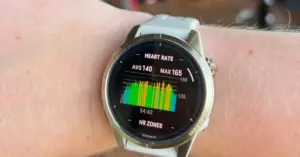
If you wear a Garmin, Coros, Apple Watch, or pretty much any modern running watch, you probably have access to more heart-rate data than you know what to do with. Resting heart rate, training zones, maximum heart rate, HRV, recovery heart rate. Then your watch takes all of that and produces even more numbers about your fitness and recovery.
Understanding the heart rate training basics can help you decide which of those numbers are worth paying attention to and, equally importantly, when to stop obsessing over them.
Heart rate is an objective measure of how your cardiovascular system is responding to exercise. As running intensity increases, your muscles require more oxygen, cardiac output increases, and your heart rate generally rises along with the workload.
That makes heart rate a valuable way to monitor running intensity. It can help you keep easy runs easy, guide harder workouts, and understand how your body responds to different training demands.
There’s one important catch though. Heart rate is affected by more than just your running pace.
Heat, dehydration, fatigue, stress, caffeine, illness, medications, and the intensity of yesterday’s workout can change the number you see on your watch. Heart-rate data needs context.
What Can Heart Rate Tell Runners?
Think of heart rate as a measure of internal workload.
Your pace tells you what you’re producing externally. Heart rate gives you information about what your cardiovascular system is doing to produce it.
Imagine two easy runs at exactly the same pace. During the first, your heart rate is sitting comfortably at 140 bpm and the run feels easy. A few days later, you run the same route at the same pace, but your heart rate is 152 bpm and the effort feels noticeably harder.
Something has changed, even though your pace hasn’t.
Maybe it’s hot, or you slept terribly. Perhaps you’re carrying fatigue from a hard workout, getting sick, or dealing with a stressful week at work. One off run doesn’t necessarily tell us much, but patterns can give you more information about how your body is responding to training and everything happening around it.
This is also why I like combining heart rate with rating of perceived exertion (RPE) rather than relying on one metric alone. You can read more about that in RPE for Running: How to Use Effort, Heart Rate, and Pace Together.
The Main Heart Rate Numbers Runners Should Understand
Your watch can give you a fairly intimidating collection of cardiovascular metrics. These are the main ones worth understanding.
| Metric | What It Means | What To Keep In Mind |
|---|---|---|
| Resting Heart Rate | Your heart rate when your body is at rest | Your own normal range and trends generally matter more than comparing yourself to another runner |
| Exercise Heart Rate | Your cardiovascular response whilst exercising | changes with intensity, heat, fatigue, hydration, stress, and other factors |
| Maximum Heart Rate | The highest heart rate you can reach during maximal exercise | Age-predicted formulas provide estimates and can be inaccurate for an individual |
| Heart Rate Zones | Intensity ranges used to guide training | they’re only as good as the information used to create them |
| Heart Rate Variability (HRV) | Variation in the time between successive heart beats | Best interpreted as a personal trend under consistent measurement conditions |
| Heart Rate Recovery | How quickly heart rate falls after exercise | Influenced by fitness, exercise intensity, and how recovery is measured. |
Let’s look at the ones that have the biggest impact on everyday running.
Resting Heart Rate: Pay Attention to Your Baseline
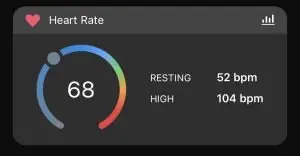
Resting heart rate is simply the number of times your heart beats per minute when you’re at rest.
Endurance training commonly results in a lower resting heart rate as cardiovascular adaptations occur. However, there’s no prize for having the lowest number in your running group.
What matters more for training purposes is understanding your normal.
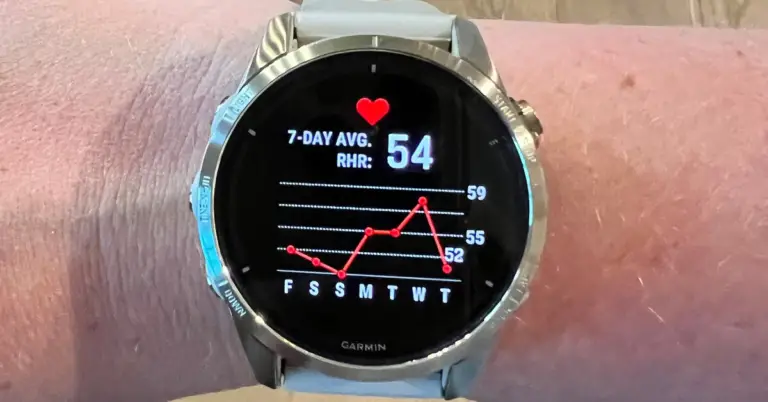
If your resting heart rate usually sits within a fairly predictable range and suddenly increases, it can be worth looking at what else is happening. Hard training, poor sleep, illness, stress, alcohol, dehydration, and other factors can all influence it.
I wouldn’t change an entire training plan because of one reading. A repeated change from your normal baseline, particularly when it lines up with fatigue or feeling unwell, gives you more reason to pay attention.
If you use your watch to monitor resting heart rate, look at the trend over time rather than judging yourself on this morning’s number.
Maximum Heart Rate: Why Your Watch May Be Guessing
Maximum heart rate, or HRmax, is the highest heart rate you can reach during maximal exercise.
This is where things often start going sideways with heart rate training.
Many watches and online calculators begin by estimating your maximum heart rate from your age. The classic formula is:
220 − age
The problem is that age-predicted equations describe population averages. They can’t tell us exactly what your maximum heart rate is.
A 40-year-old runner with a true maximum heart rate of 195 bpm and another 40-year-old with a maximum of 175 bpm can both be completely normal. Give them both an estimated max of 180 and their calculated training zones may be quite different from their actual physiology.
There are better prediction equations than 220 minus age, including the commonly used Tanaka equation, but they’re still predictions.
Heart-Rate Zones: Where the Numbers Become Training
Heart-rate zones divide exercise intensity into ranges so you can match the intensity of a run with the purpose of the workout.
Easy aerobic running should feel very different from a threshold session or hard interval workout, and your heart-rate response should reflect that difference.
The tricky part is that there isn’t one universal zone system. You’ll see three-zone models, five-zone models and sometimes seven zones. Different platforms may calculate boundaries using percentages of maximum heart rate, heart-rate reserve, lactate threshold, or physiological thresholds.
That means someone saying, “I ran in Zone 2,” doesn’t necessarily tell me very much until I know how their Zone 2 was calculated.
Recent research in distance runners has also demonstrated individual variation in the percentage of peak heart rate at which ventilatory thresholds occur. This is one reason I prefer individualized thresholds when we have access to them.
If you want the practical breakdown of how to train with zones, read Heart Rate Training for Runners: How to Actually Use Your Zones.
What About HRV?
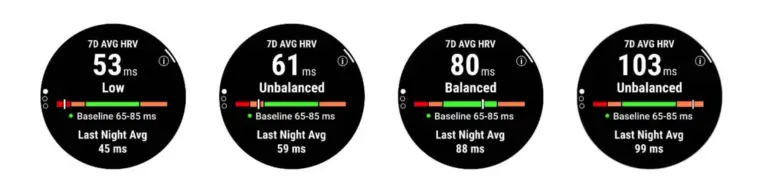
Heart-rate variability, usually shortened to HRV, is the variation in time between consecutive heartbeats.
HRV has become much more visible now that watches, rings, and other wearables measure it automatically. It can provide information about autonomic nervous system activity and how your body is responding to training and other stressors.
The interpretation needs more nuance than “higher HRV is good and lower HRV is bad.”
Age, fitness, genetics, sleep, alcohol, psychological stress, training load, measurement timing, and even body position can influence HRV. Different devices may also measure and report it differently.
For runners who want to track HRV, consistent measurements and longer-term trends are generally more informative than reacting to a single morning score.
What Affects Your Heart Rate While Running?
This is one of the most important parts of heart-rate training to understand.
Your normal easy run heart rate won’t necessarily always be the same, even when the run itself looks similar.
Factors that can change your heart-rate response include:
- Heat and humidity
- Hydration status
- Sleep
- Psychological stress
- Illness
- Accumulated training fatigue
- Caffeine and other stimulants
- Alcohol
- Some medications
- Changes in terrain or elevation
- Exercise duration
This is why I don’t recommend blindly chasing a heart-rate number.
Heat is an obvious example. Your heart rate can gradually rise during prolonged running as cardiovascular drift occurs, even when your pace remains fairly steady. If you train through hot summers or travel for warm-weather races, read Heart Rate and Heat: Why It Spikes and How to Adjust Your Training.
Heart rate provides information. You still need to interpret that information based on what’s happening around you.
Do You Need a Chest Strap?
Probably not for every run.
Wrist-based optical heart-rate monitors have improved considerably and research shows that many devices can measure heart rate reasonably well during common activities, including steady treadmill running.
Accuracy can still vary by device, activity and exercise intensity. Rapid changes in intensity and movement can create more problems for some optical sensors.
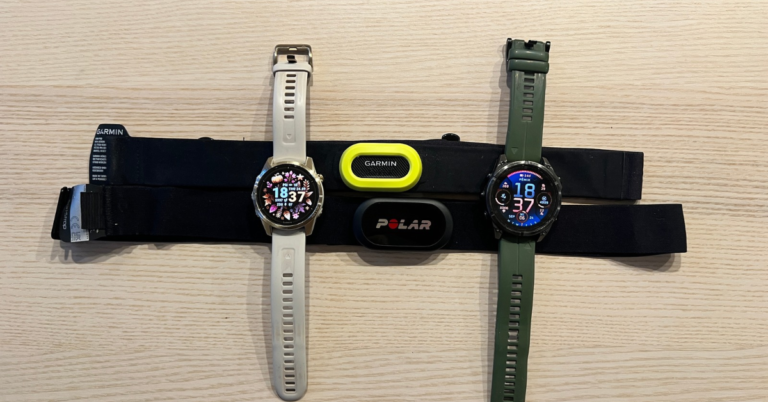
A chest strap measures the electrical signal associated with each heartbeat and is generally my preference when someone needs more dependable exercise heart-rate data, particularly for interval training, physiological testing, or when we’re trying to figure out whether unusual watch readings are real.
You don’t necessarily need more technology, but having data that’s accurate enough for the decision you’re trying to make is something to consider.
Heart Rate Is One Tool in Your Training Kit
If there’s one thing I want runners to take from this article, it’s that your heart rate isn’t a grade.
A high number doesn’t automatically mean you’re unfit. A low number doesn’t automatically mean the workout was better. Your Garmin doesn’t know that your kid woke you up three times last night, that it’s 35°C outside, or that you’re carrying fatigue from Sunday’s long run.
Look at heart rate alongside pace, RPE, the purpose of the workout and how you’re recovering across the week.
Over time, you start to recognize your own patterns. You know roughly what an easy run feels like and where your heart rate usually sits. Over time, it becomes easier to spot when an easy pace feels harder than expected, or when conditions explain an unusual heart rate response. That context can also help you recognize when something genuinely seems off.
When More Accurate Heart-Rate Zones Can Help
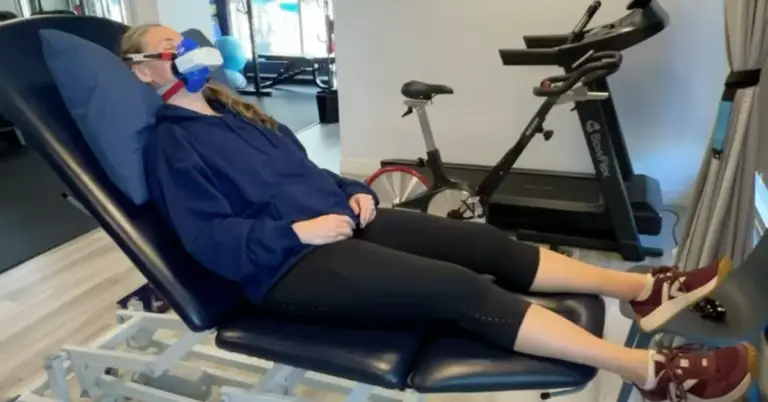
If your watch zones have never made sense, your supposedly easy runs feel much too hard, or you’re preparing for a race and want more individualized training targets, physiological testing can give you better information.
During a VO₂ max test, we measure your cardiovascular and respiratory response as exercise intensity progressively increases. This allows us to identify your maximum heart rate and ventilatory thresholds, then establish heart-rate and pace zones based on your own physiology.
Research increasingly supports prescribing exercise relative to individual physiological thresholds where those measurements are available.
Key Takeaways
- Heart rate gives you objective information about your cardiovascular response to running.
- Pace, heart rate, and RPE provide different information and work well together.
- Resting heart rate is best interpreted relative to your own normal baseline.
- Maximum heart rate formulas are estimates and can produce inaccurate zones for individual runners.
- Heart rate zone systems vary, so a zone number only makes sense when you know how it was calculated.
- HRV should be interpreted as an individual trend rather than a simple higher-is-better score.
- Heat, hydration, sleep, stress, illness, medications, and training fatigue can all change heart rate.
- Wrist monitors can provide reasonable data for many runs, while chest straps may be preferable when greater accuracy matters.
- VO₂ max testing can identify ventilatory thresholds and individualized heart-rate zones.
Tired of Guessing Your Heart-Rate Zones?
If you’re local to Vancouver, I offer VO₂ max testing in Port Moody. Testing measures your VO₂ max, maximum heart rate, and ventilatory thresholds so we can establish individualized heart-rate and pace zones based on your physiology.
Frequently Asked Questions About Heart Rate Training
Heart rate training uses your heart rate to help guide running intensity. Because heart rate reflects your cardiovascular response to exercise, it can help distinguish easy aerobic running from moderate and harder training when interpreted alongside factors such as RPE, pace and environmental conditions.
There isn’t one correct running heart rate for everyone. Appropriate heart rate depends on your physiology, training goal, fitness, maximum heart rate, ventilatory or lactate thresholds, and the type of run you’re doing. Age-predicted formulas can provide estimates, while physiological testing can establish more individualized zones.
The 220 minus age formula provides a population-level estimate and can be inaccurate for an individual. Other prediction equations, such as the Tanaka equation, may provide better estimates in some populations, but measuring maximum heart rate through appropriate exercise testing gives more individualized information.
Heat, dehydration, fatigue, poor sleep, stress, illness, caffeine, medications, elevation, and accumulated training load can all affect heart rate. Look at the context and whether the change persists rather than assuming one unusual run means your fitness has changed.
Chest-strap heart-rate monitors generally provide very accurate heart-rate measurements and are commonly used as reference devices in wearable research. Many modern wrist-based monitors also perform reasonably well during running, although accuracy varies by device and activity.
Yes. A VO₂ max test with gas analysis can identify ventilatory thresholds and the heart rates associated with them. Those measurements can be used to establish individualized training zones rather than relying only on age-predicted percentages.
References
Esco, M. R., Fields, A. D., Mohammadnabi, M. A., & Kliszczewicz, B. M. (2025). Monitoring Training Adaptation and Recovery Status in Athletes Using Heart Rate Variability via Mobile Devices: A Narrative Review. Sensors (Basel, Switzerland), 26(1), 3. https://doi.org/10.3390/s26010003
Esteve-Lanao, J., Sellés-Pérez, S., Arévalo-Chico, H., & Cejuela, R. (2026). Towards Accurate Reference Values for Heart Rate and Speed Zones by Aerobic Fitness and Sex in Long-Distance Runners. Sports (Basel, Switzerland), 14(1), 29. https://doi.org/10.3390/sports14010029
Meyler, S. J. R., Swinton, P. A., Bottoms, L., Dalleck, L. C., Hunter, B., Sarzynski, M. A., Wellsted, D., Williams, C. J., & Muniz-Pumares, D. (2025). Changes in Cardiorespiratory Fitness Following Exercise Training Prescribed Relative to Traditional Intensity Anchors and Physiological Thresholds: A Systematic Review with Meta-analysis of Individual Participant Data. Sports medicine (Auckland, N.Z.), 55(2), 301–323. https://doi.org/10.1007/s40279-024-02125-x
Tanaka, H., Monahan, K. D., & Seals, D. R. (2001). Age-predicted maximal heart rate revisited. Journal of the American College of Cardiology, 37(1), 153–156. https://doi.org/10.1016/s0735-1097(00)01054-8
Zhang, Y., Weaver, R. G., Armstrong, B., Burkart, S., Zhang, S., & Beets, M. W. (2020). Validity of Wrist-Worn photoplethysmography devices to measure heart rate: A systematic review and meta-analysis. Journal of sports sciences, 38(17), 2021–2034. https://doi.org/10.1080/02640414.2020.1767348