Using RPE for running is one of the simplest ways to gauge how hard a workout actually feels. It can be especially useful on days when the numbers on your watch don’t quite match what your body is telling you.
RPE stands for rating of perceived exertion, and it gives you a subjective measure of exercise intensity. I use the Borg CR10 scale with runners, where 0 represents no exertion and 10 represents a maximal effort. Your rating is based on your overall sense of effort, including your breathing, how hard your muscles are working and how difficult it feels to maintain the pace.
That information becomes even more valuable when you combine it with objective measures such as heart rate and pace. Each tells you something slightly different. Pace shows how fast you’re moving, heart rate reflects your cardiovascular response to the workload, and RPE tells you how hard that workload feels on that particular day.
Most of the time, those pieces of information make sense together. An easy run might feel like an RPE 3, sit comfortably within your usual easy heart-rate range and happen at a familiar pace. But training doesn’t always happen under perfect conditions. Heat, hills, fatigue, poor sleep, stress and accumulated training load can all change the relationship between pace, heart rate and perceived effort.
Knowing how to use RPE gives you another tool for interpreting what’s happening and adjusting your training when needed.
What Is the RPE Scale for Running?
RPE can be measured using different scales. Two of the most commonly used are the original Borg 6-20 scale and the newer Borg CR10 scale. The 6-20 scale was designed so that during steady aerobic exercise, multiplying the RPE by 10 would roughly correspond with heart rate, for example an RPE of 12 might align with a heart rate of about 120 bpm. The CR10 scale uses a simpler 0-10 format, which I find more intuitive and practical for most runners.
You don’t need to become overly precise about whether your run was a 3 or a 3.5. RPE is more beneficial when you learn to recognize broader levels of effort and what those feel like in your own body.
An easy run should feel noticeably different from a progression run. Threshold work should feel different again. As you become more familiar with those sensations, you start to recognize changes in breathing, muscular effort, concentration and your ability to talk.
Here’s a practical way to think about the CR10 scale for running:
| RPE | How It Feels | Talk Test | Where You Might Use It |
|---|---|---|---|
| 0-1 | Rest to very light | Normal conversation | Rest, walking, very easy warm up |
| 2-3 | Easy and relaxed | Full sentences comfortably | Recover runs, easy aerobic training |
| 4 | Comfortable but purposeful | Full sentences, breathing more noticeable | Upper end of easy running, controlled aerobic work |
| 5-6 | Moderate to moderately hard | Shorter sentences | Steady state runs, progression runs, some longer efforts |
| 7 | Hard but controlled | Short phrases | Tempo and threshold work |
| 8 | Very hard | A few words | Hard intervals, hills, harder race efforts |
| 9 | Extremely hard | Talking is difficult | Short hard intervals, late race efforts |
| 10 | Maximal | No words | Sprinting, final kick, very short maximal efforts |
These are practical training ranges rather than exact physiological zones. Fitness, workout duration, terrain, environmental conditions and individual physiology all influence how a given effort feels.
That’s also why RPE works best when you understand the purpose of the session rather than trying to assign one exact number to every type of workout.
What Different RPE Levels Feel Like in the Real World
An RPE chart is helpful, but sometimes it’s easier when you can connect the number to something you’ve actually experienced on a run.
At RPE 2 to 3, running should feel genuinely easy. Your breathing is controlled, your stride feels relaxed and you could have a proper conversation without carefully timing your words between breaths. Most easy aerobic and recovery running should live somewhere around here.
RPE 4 is still controlled, but you’re more aware that you’re exercising. You may be moving toward the upper end of your easy range, depending on the purpose of the run and your individual physiology.
Once you reach RPE 5 to 6, you’re clearly working. Breathing becomes deeper and conversation gets shorter, but the effort is still manageable. You might experience this during a steady state run, the later stages of a progression run, or a section of a long run where the goal is to increase intensity without turning it into a hard interval session.
At RPE 7, the effort becomes distinctly hard but controlled. You need to concentrate on maintaining it, your breathing is strong and conversation is limited to short phrases. This is the territory many runners associate with tempo or threshold-type training, although the exact relationship between RPE and physiological threshold varies between individuals.
Move into RPE 8 to 9 and the effort is much harder. You know you can maintain it for the prescribed interval, but you’re also very aware that the interval has an end. These ratings are more likely to appear during hard repetitions, hill intervals or demanding race efforts.
An RPE 10 is maximal. There’s no meaningful reserve left, and you couldn’t sustain the effort for long. Think the finishing kick of a sprint effort.
One important point here is that RPE can change during a workout even when pace stays the same. Running 5:30/km for the first five minutes of a sustained effort may feel very different from running 5:30/km 30 minutes later. Duration, fatigue and environmental stress all contribute to your perception of effort.
RPE vs Heart Rate vs Pace
Us runners love data, and modern watches can give us a lot of it. The challenge is knowing what each number actually tells you. I don’t see RPE, heart rate and pace as competing methods. They’re different tools in the same kit.
Pace is an external measure. It tells you how quickly you’re covering distance.
Heart rate is an internal, objective measure. It gives you information about how your cardiovascular system is responding to the workload.
RPE is an internal, subjective measure. It tells you how hard the effort feels.
Imagine that on a typical cool-weather easy run, you’re running around 6:00/km, your heart rate is 140 beats per minute and the effort feels like an RPE 3. Everything lines up nicely.
Now imagine you head out at the same pace during a hot afternoon. Your heart rate climbs to 155, and the run feels more like an RPE 5 or 6. The pace hasn’t changed, but the cost of producing that pace has.
If the goal for the day was easy aerobic running, continuing to force your usual pace simply because that’s what you normally run could turn the session into something harder than intended.
This is where RPE becomes advantageous. It gives you additional context for the numbers on your watch rather than asking you to ignore them.
If you want to understand heart rate zones in more detail, you might like to check out Heart Rate Training for Runners: How to Actually Use Your Zones
When RPE Is Particularly Beneficial
You can use RPE during any run, but there are situations where pace or heart rate may become harder to interpret on their own.
Running in Heat and Humidity
Heat is a great example.
During prolonged running, particularly in hot conditions, heart rate can gradually increase even when your running speed remains relatively steady. This is part of a physiological response known as cardiovascular drift.
As your body works to move blood toward the skin for cooling, and factors such as thermal strain and fluid loss come into play, the relationship between pace and heart rate can look different from what you’re used to seeing in cooler conditions.
That doesn’t make heart rate useless in the heat, but you need to interpret it within the context of the conditions.
Suppose your normal easy effort is around RPE 3. If the same pace suddenly feels like RPE 6 on a hot day and your heart rate is well above its usual range, that’s a pretty good indication that your body is working harder than it normally would.
Slowing down allows you to preserve the intent of the workout, and not impact your total weekly load.
[Related: Heart Rate and Heat: Why It Spikes and How to Adjust Your Training.]
Hills, Trails, and Variable Terrain
Terrain changes is another great example of where pace may not be so helpful.
Trying to hold your usual road pace while running uphill is a quick way to turn an easy run into a hard one. The opposite happens on descents, where pace may increase even though the cardiovascular effort remains controlled.
On rolling routes or trails, running to an appropriate effort can make much more sense than trying to force the same pace on every kilometre.
Fatigue, Stress, and Poor Sleep
Your body doesn’t separate your training stress from everything else happening in your life.
A demanding week at work, poor sleep, accumulated training fatigue, inadequate fuelling or simply having a lot going on can change how a familiar workout feels.
If your planned easy pace, normal heart rate and RPE are all quite different from usual, that pattern may tell you more than any one number by itself.
Can You Train Using RPE Without a Heart Rate Monitor?
Yes. One of the advantages of RPE is that it requires no equipment.
In fact, learning to recognize different effort levels without the data can make you a more adaptable runner. Your watch battery can die, GPS can struggle under tree cover or in highly dense city areas, a race course can be hillier than expected, or the weather can completely change what your planned pace feels like.
Being able to recognize an easy, steady, threshold or very hard effort gives you another way to manage the session.
If you do use a heart-rate monitor, you don’t have to choose between the two. Over time, you can start connecting the subjective and objective information.
You might notice that your easy runs typically feel like RPE 2 to 3 and fall within a predictable heart-rate range. You may start to recognize the breathing and effort changes that occur as you approach your threshold. You’ll also become better at spotting days when your usual numbers don’t match how your body feels.
Where VO2 Max Testing Fits In
RPE helps you understand your perception of effort, but there are times when more precise physiological information can really help.
One of the common problems I see is runners relying on generic watch-generated heart-rate zones that don’t seem to match their actual training. Their watch may insist they’re working extremely hard while they feel comfortable, or their supposed easy zone may feel anything but easy.
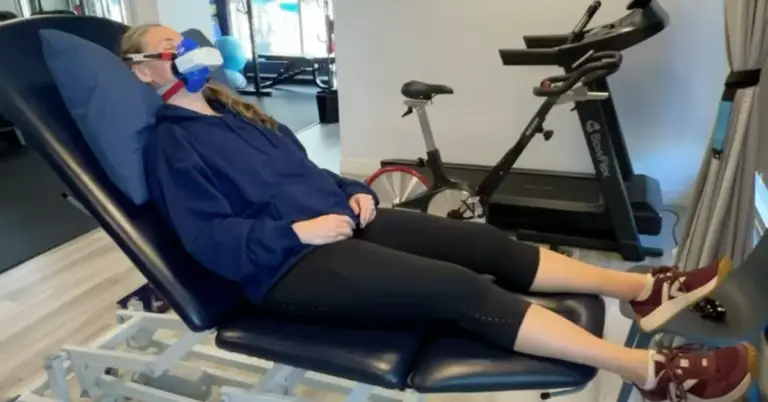
A VO2 max test measures more than your VO2 max number. During testing, we can identify your maximum heart rate and ventilatory thresholds, then use those measurements to establish individualized training zones.
That gives you an objective baseline to combine with your RPE and pace.
For example, you may learn where your aerobic and threshold intensities occur physiologically, what heart rates and paces correspond with them, and what those efforts feel like in your own body. The more you connect those pieces, the less you have to guess when conditions or workouts change.
VO2 max testing can be of value if your current heart-rate zones don’t seem to make sense, you want more precise guidance for training intensity, or you’re preparing for a race and want to understand your physiology in more detail.
The Bottom Line on RPE for Running
RPE for running gives you information that pace and heart rate can’t provide on their own: how hard the workload actually feels to you.
I’m not saying stop using your watch, I’m the biggest Garmin nerd you’ll find. But getting a feel for your true RPE is a great skill for runners to learn. Pace, heart rate and RPE can work very well together because they measure different aspects of the same training session.
On a straightforward day, all three may line up exactly as expected. On another day, heat, hills, fatigue or stress may change the picture.
Learning how different effort levels feel gives you another way to make smart training decisions and maintain the intended purpose of your workout, even when the numbers aren’t quite what you expected.
Key Takeaways
- RPE stands for rating of perceived exertion and describes how hard exercise feels.
- Easy running will commonly feel around RPE 2 to 4, while steady state, threshold and interval sessions progressively move higher up the scale.
- RPE ranges are practical guides rather than exact physiological zones.
- Pace, heart rate and RPE measure different aspects of your training, and they’re often most useful when interpreted together.
- RPE can be particularly helpful in heat, on hills and trails, or when fatigue and life stress change how a familiar pace feels.
- VO2 max testing can provide individualized heart-rate zones and ventilatory thresholds that you can then connect with pace and perceived effort.
Want to Know Where Your Training Zones Actually Are?
If your watch zones don’t match how your running feels, or you’re tired of guessing where your easy, moderate and threshold intensities should sit, physiological testing can give you a more individualized starting point.
If you’re local to Vancouver, I offer VO₂ max testing in Port Moody. This test measures your VO2 max, maximum heart rate and ventilatory thresholds, and we can then use those results to establish personalized training zones and practical workout guidelines.
You can also subscribe to my newsletter or follow me on Instagram for more evidence based tips for runners.
Frequently Asked Questions About RPE for Running
RPE stands for rating of perceived exertion. It measures how hard a running effort feels based on factors such as breathing, muscular effort and the overall difficulty of maintaining the pace. RPE can be used on its own or alongside heart rate and pace.
Using the CR10 scale, most easy running will commonly fall around RPE 2 to 4. You should feel controlled and able to speak in full sentences. The exact number can vary between runners and across different conditions.
Threshold-type running will often feel around RPE 7, sometimes moving toward 8 depending on the duration and workout design. It should feel hard but controlled, with strong breathing and limited conversation. RPE shouldn’t be treated as an exact substitute for measured physiological thresholds.
Neither is universally better. Heart rate provides objective information about your cardiovascular response, while RPE describes your subjective perception of effort. Using both, along with pace when appropriate, can provide more context than relying on a single metric.
RPE can be especially helpful in hot weather because heat changes the relationship between pace, heart rate and effort. Heart rate may rise during prolonged exercise in the heat even if your pace remains steady, so RPE can help you judge whether the session still feels appropriately easy, moderate, or hard.
Yes. RPE requires no equipment and can be used to guide easy runs, steady running and harder workouts. Learning how different intensities feel can also help when GPS, terrain, weather or race conditions make pace less reliable.
Physiological testing can provide more individualized information than generic age-predicted formulas. VO2 max testing can measure maximum heart rate and ventilatory thresholds, which can then be used to establish personalized training zones.
References
Arantes Bertochi, G. F., Mota, G. R., Haile, L., Marocolo, M., & Eidi Sasaki, J. (2023). Validity of Weekly and Monthly Perceived Exertion in Runners. International journal of sports medicine, 44(11), 763–777. https://doi.org/10.1055/a-2058-8049
Borg G. (1990). Psychophysical scaling with applications in physical work and the perception of exertion. Scandinavian journal of work, environment & health, 16 Suppl 1, 55–58. https://doi.org/10.5271/sjweh.1815
Borg G. A. (1982). Psychophysical bases of perceived exertion. Medicine and science in sports and exercise, 14(5), 377–381.
Lopes, T. R., Pereira, H. M., & Silva, B. M. (2022). Perceived Exertion: Revisiting the History and Updating the Neurophysiology and the Practical Applications. International journal of environmental research and public health, 19(21), 14439. https://doi.org/10.3390/ijerph192114439
Torres, G., Maia, F., Nakamura, F. Y., Neiva, H. P., & Sousa, A. (2025). Rating of perceived exertion in continuous sports: a scoping review with evidence gap map. Frontiers in sports and active living, 7, 1553998. https://doi.org/10.3389/fspor.2025.1553998
Wingo, J. E., Stone, T., & Ng, J. (2020). Cardiovascular Drift and Maximal Oxygen Uptake during Running and Cycling in the Heat. Medicine and science in sports and exercise, 52(9), 1924–1932. https://doi.org/10.1249/MSS.0000000000002324