Running form is one of the most overcomplicated topics in the running world. Everyone has an opinion, and half of those opinions come with a slow motion video and a link to buy some orthotics to “fix their pronation”.
Here’s the problem. When runners get fed the wrong form advice, they either start drastically changing things that don’t need changing, or they ignore the actual driver of their pain.
Sometimes form matters, but sometimes it isn’t what’s actually causing pain or injuries.
In this post, we’ll cover the most common running form myths that lead to confusion, frustration, and repeat injuries, and what to focus on instead.
[Related: What Is A Running Assessment?]
Myth 1: Heel striking is bad
Heel striking is one of the most demonised topics in running. It’s also one of the most misunderstood. A lot of runners have been told that landing on the heel is automatically wrong and needs to be fixed. That’s not what the research shows.
In one study of almost 2,000 runners at a 2011 marathon, 93 percent were heel strikers1. Now whilst this study didn’t report on injury rate, it’s a safe assumption that we would have heard about a race with 93% of participants being injured from heel striking! A 2019 study in the Journal of Biomechanics analyzed foot-strike patterns of elite runners from the 2017 World Championships in London2. They found that 67% of male runners and 73% of female runners landed heel first, regardless of finishing place or ethnicity.
Heel striking on its own is not the problem. What matters more is where your foot lands relative to your centre of gravity, the amount of flexion at the knee at contact, and how you manage your load overall.
If your foot is reaching too far out in front, you are more likely to be overstriding. That can create more braking, make running less efficient, and increase stress through the hips, knees, and lower back.
This is also why changing foot strike is not always the answer. In some cases, trying to force a different landing pattern can simply shift the problem somewhere else.
A better place to focus is overall running form, not just foot strike. Cadence, posture, and where your foot is landing under your body usually matter more than whether you land heel first.
Myth 2: Everyone should run at a cadence of 180
Cadence has become the running world’s favourite magic number.
A lot of runners have heard that 180 steps per minute is the number to aim for, full stop. That idea largely came from coach Jack Daniels, who observed that most runners at the 1984 Olympics were running at a cadence of at least 180. The important word there is observed. That doesn’t mean 180 is the correct target for every runner.
Cadence is individual. It can be influenced by things like height, leg length, speed, and injury history. Taller runners, for example, will often have a slightly lower cadence simply due to leg length difference, they don’t need to take as many steps to cover the same amount of ground.
That said, cadence still matters.
A slightly higher cadence can help reduce overstriding, which often matters more than whether someone is landing on their heel or not. As mentioned above, with foot strike, the bigger question is where the foot is landing relative to the body. A heel strike is not automatically a problem if the foot is landing in a reasonable position and the overall mechanics make sense.
Cadence also affects efficiency. A slower cadence usually means more time spent on the ground with each step. That longer stance phase can make your stride feel less springy and less efficient. In simple terms, you spend longer absorbing force and get less back from it.
Lower cadence has also been linked with poorer running economy and higher joint loading through the hips, knees, and ankles.
That doesn’t mean everyone needs to chase 180, but it does mean cadence is worth paying attention to.
For most runners, a range of roughly 170 to 190 steps per minute is a more useful guide than one exact number. And if someone is sitting quite low, especially around 160 or below, a small increase can sometimes help. The key word is small. We want to make this change gradually, with an increase of approximately 5 steps per minute at a time.
Cadence work is often easiest on the treadmill, where speed and terrain are controlled. A metronome app on your phone or watch can help too.
[Related: What Happens During A Running Assessment?]
Myth 3: Overpronation is always the problem
Everybody pronates. It’s a normal part of foot mechanics, not something that your body is doing wrong.
The problem is that runners have been told for years that if their foot rolls in at all, they need to correct it with a more controlling stability shoe. That thinking has led a lot of people to treat normal foot motion like a flaw.
Sometimes pronation is excessive for your current capacity, and sometimes it does contribute to symptoms. Even then, it’s rarely the whole story. More often, it sits within a bigger picture that includes strength, mobility, training load, fatigue, and how well the foot is coping with the demands placed on it.
A better approach is to look at whether your symptoms line up with certain tissues being overloaded, how much strength and control you have through the foot, calf, hip, and trunk; and whether shoes or insoles are being used strategically rather than as a permanent crutch. A point to consider is whether the footwear or insoles are helping, or simply trying to do a job that your body isn’t managing well on its own.
Myth 4: Your shoes are causing your injury
Shoes can matter. They can change loading patterns, and they can make symptoms better or worse.
But the issue is usually bigger than just the shoes.
For years, runners were often told they needed more support, more control, or a more corrective shoe any time their foot moved in a way that looked less than perfect. In a lot of cases, that advice was driven more by marketing than by what the runner actually needed.
If your training load has jumped, your sleep has been poor, or you have been underfuelling, switching shoes won’t magically fix the problem.
It makes more sense to look at your overall training load versus your capacity to manage it, how quickly your training has progressed, and whether your tissues are strong enough for what you’re asking them to do. Shoes can support a smart plan, but they are not a substitute for one. Many running injuries are simply a case of “you did too much, too soon”.
Myth 5: The fix is always more running
When running feels hard, many runners try to solve it by running more, thinking that they just need to get better at it.
Sometimes that works. Often it backfires, especially if your strength, recovery, and fuelling aren’t keeping up with your training load.
What usually helps more is a training plan with actual easy days, strength work that supports your running, recovery habits that keep capacity high, and progressions that match your current life stress instead of ignoring it. It’s important to remember that as far as your body is concerned, stress is stress. That may be physical stress from workouts, or mental and emotional stress from other areas of your life.
Myth 6: If it hurts, your form must be wrong
Pain is information, but it’s not always a “form problem.”
You can have great mechanics and still get injured if your load is too high. You can also have a “messy” looking stride and be completely pain free. Your running form can absolutely impact your performance, but it’s not necessarily always the cause of injury.
A better question is when the pain shows up, how it changes with load, whether fatigue changes your mechanics, and whether strength or mobility factors are affecting your tolerance. It is also worth asking whether you are trying to train through a warning sign instead of adjusting early. That is something that all of us runners could be better at doing!
What Actually Helps Most Runners
If you want a simple filter for running form advice, use this:
- Does this change actually match my problem?
- Can I practise it consistently without it turning into something overwhelming that I won’t keep up with?
- Does it help my symptoms or performance within a few weeks?
- Am I also addressing training load, strength, and recovery?
If the answer is no, it might not be the best advice for you right now.
Ready to Stop Guessing?
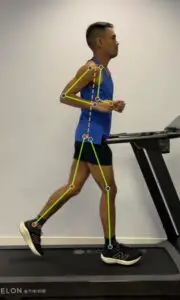
If you keep getting the same niggle, or you’re stuck Googling “is my form bad” at midnight, book a running assessment in Port Moody. We’ll look at how you run on the treadmill, assess your strength and mobility, and map out the few changes that will matter most.
You may leave with a couple of simple cues or drills. You may also find that your mechanics look fine and the bigger issue is training load, strength, mobility, or recovery. We don’t fix what’s not broken, you won’t leave with unnecessary things to “fix”.
Want more running science without the overwhelm? Subscribe to my newsletter or follow me on Instagram for weekly tips on running, strength, and recovery.
FREQUENTLY ASKED QUESTIONS ABOUT RUNNING FORM
Heel striking is common and often completely fine. What matters more is where your foot lands relative to your body, how much you are overstriding, and how you manage training load.
Not necessarily. Cadence depends on things like height, leg length, speed, and injury history. Some runners benefit from a small increase, but forcing 180 is not the answer for everyone.
Shoes can change loading patterns and affect symptoms, but they are rarely the whole story. Injuries are usually influenced by training load, recovery, strength, and tissue tolerance as well.
Sometimes, but not always. Many injuries are driven more by training load and capacity than technique alone. If your form is working well, we don’t change it.
Not necessarily. Pronation is a normal part of foot mechanics. It only becomes a concern when it exceeds what your body can currently tolerate and starts contributing to symptoms.
References:
- Kasmer ME, Liu X-C, Roberts KG, Valadao JM. Foot-strike pattern and performance in a marathon. International Journal of Sports Physiology and Performance. 2013;8(3):286-292. doi:10.1123/ijspp.8.3.286. PMID: 23006790 ↩︎
- Hanley B, Bissas A, Merlino S, Gruber AH. Most marathon runners at the 2017 IAAF World Championships were rearfoot strikers, and most did not change footstrike pattern. Journal of Biomechanics. 2019;92:54-60. doi:10.1016/j.jbiomech.2019.05.024. PMID: 31147098 ↩︎