Open social media and half the posts you see will say “runners need high-rep light weight strength training”. Then the other half will say “runners have to lift heavy.” If you’re also confused by how heavy runners should lift, this post is for you.
Most runners either go too light (because they’re worried it’ll wreck their legs), or they go too hard (and wonder why their next run feels like they’re wearing concrete shoes).
A practical way to choose load is to use reps and effort together. You don’t need a perfect percentage chart or a mysterious “runner-specific” number. You need two things you can actually use on a busy week.
- Reps (how many you can do)
- Effort (how hard that set felt, using RPE and reps in reserve)
Strength training, especially heavier strength and plyometric style work, has been shown to improve running economy in middle and long distance runners. Running economy is essentially how efficient you are, meaning you can often do the same pace with less energy cost.
Let’s check what the literature says, and make “how heavy runners should lift” clear.
What “heavy enough” means for runners
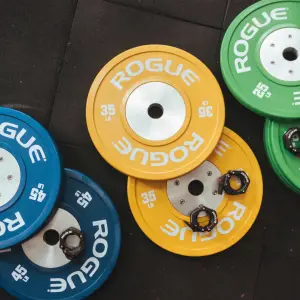
“Heavy” is relative. For one runner, heavy is a barbell deadlift loaded with six plates. But for another, heavy might be a goblet squat with a 25 lb dumbbell done well.
For all runners, most of your strength work should land in the sweat spot of heavy enough to be challenging, light enough to not trash your legs for 3 days.
Two simple tools that make lifting load easy
You may have heard of Rating of Perceived Exertion (RPE) used in running, it’s a way to describe how hard the set felt. Borg’s classic work explains the “psychophysical” idea behind it, your brain can reliably rate effort when you use the scale consistently.
For strength training, a super practical version is the reps in reserve (RIR) based RPE scale. This is simply where you rate the set based on how many reps you had left.
Here’s the translation:
- RPE 6 = you could have done ~4 reps more (4 RIR)
- RPE 7 = ~3 reps more (3 RIR)
- RPE 8 = ~2 reps more (2 RIR)
- RPE 9 = ~1 rep more (1 RIR)
- RPE 10 = zero reps left, true max effort
The research behind RIR-based RPE shows people can use it to estimate proximity to failure, and it’s been discussed as a practical tool for prescribing and adjusting training.
This is valuable to use for a few reasons – your week changes, sleep changes, work stress changes, and long runs sometimes don’t go to plan. If your strength plan says “3 sets of 5” but you feel cooked, RPE lets you adjust the weight without guessing, and still hit the 3 sets of 5.
The “how heavy” targets that work for most runners
For most runners, the simplest way to choose load is to aim for a consistent effort target on your working sets, rather than chasing a perfect percentage or a specific rep range. A good default is an RPE of 8, which usually means you finish the set feeling like you could have done about two more reps with good form.
The current literature shows that outcomes like building muscle can happen across a wide range of reps. Just as long as sets are taken sufficiently close to failure and total work is appropriate. For runners, the practical takeaway is simpler: pick a rep range that lets you keep form clean, reps consistent, and fatigue manageable. Then use RPE to make sure the set is actually challenging.
If you want a quick starting point, use this and adjust from there based on how your running is going:
- Main lifts: 4 to 12 reps, 3-4 sets, aiming for an RPE of 8 most weeks.
- Accessories: 10 to 15 reps, 2-3 sets aiming for an RPE of 8.
The most common mistake: lifting too light, forever
If you finish every set thinking, “I could’ve done another 10 reps”, you’re just training the movement, and not improving strength.
A quick self-check:
- If your last 2 reps look identical to your first 2 reps and you feel nothing, it’s probably too light.
- If you’ve lost your technique, and you can barely get through the last 3 reps, it’s probably too heavy.
We want challenging reps with good form.
How to choose your weight
Your goal is simple, pick a load that lands you at an RPE of 8 on your working sets, that should feel like you can finish with proper technique with ~2 reps left in the tank.
Here’s the quick method.
Start with a weight you know you can move well for your planned reps. Do one set. Ask yourself, “How many reps did I have left if I had to keep my form?” If the answer is more than about two reps, add a small amount of weight and try again. If the answer is about two reps, you’ve found your working weight. Stay there for your remaining sets. If the answer is one rep left or none, drop the load slightly so you’re back at an RPE of 8.
This is also why I like RPE for runners. It gives you a consistent target even when your week is chaotic, and it avoids the trap of forcing a number on a day your body is not having it
Deload weeks are the exception. Just the same as a drop back week in your run training, that’s when you intentionally pull back effort and let fatigue drop, which is when an RPE of 6 makes more sense.
How heavy should runners lift during big run weeks?
During peak run weeks, you still want to keep strength training in the plan without letting it affect your running. Your anchor stays the same, most working sets still aim for an RPE of 8. What might change is how much you do, and sometimes which lifts you choose.
Start by adjusting volume first. If your legs feel flat, your sleep is off, or you’ve stacked a long run and a workout close together, keep the same exercises and loads, but drop the number of hard sets. For example, if you normally do three working sets at an RPE of 8, do two. If you normally do two, do one. This keeps the strength signal there, without piling on extra fatigue.
Next, keep the session focused. Peak weeks are not the time to add new exercises or tack on extra finishers.
Example sessions, push/pull split
These are two strength sessions organised as a push day and a pull day, and most working sets land at an RPE of 8.
Push day
- Lower body push
Squat variation or leg press
3 sets x 4-8 reps at an RPE of 8 - Upper body push
Dumbbell bench press, incline press, or push-up variation
3 sets x 5-10 reps at an RPE of 8 - Single leg strength
Rear foot elevated split squat or step-ups
2-3 sets x 10-15 reps each side at an RPE of 8 - Calves
Single leg calf raise
2-3 sets x 10-15 reps each side at an RPE of 8 - Core
Dead bug or side plank variation
2-3 sets for time
Pull day
- Lower body pull (main lift)
Trap bar or barbell deadlift, RDL, or hip hinge variation
3 sets x 4-8 reps at an RPE of 8 - Upper body pull
1 arm row, chest-supported row, or lat pulldown
3 sets x 6-10 reps at an RPE of 8 - Posterior chain support
Hamstring curl or hip thrust
2-3 sets x 6-12 reps at an RPE of 8 - Shins and foot support
Tibialis posterior biased calf raise
2-3 sets x 10-15 reps at an RPE of 8 - Core
A single arm carry or bird dog variation
2-3 sets for time
[Browse Strength for Runners Programs]
Key takeaways
- “Heavy” is relative. Aim for weights that feel challenging while you can keep good form and still run well.
- Use reps plus effort to choose load. A simple default is an RPE of 8 on most working sets, about two reps left with solid form.
- If you feel like you could have done another 10 reps, it was too light. If you’re losing technique and struggling significantly, it was too heavy.
- Use RPE to adjust on those weeks where life is life-ing. Sleep, stress, and illness can change things, your lifting load should be able to flex with that.
- During big run weeks, keep the RPE anchor the same and reduce volume first. Fewer hard sets beats changing everything.
Want help applying this to your week?
If you want strength training that fits into your running life, with clear progressions and guidance on how hard to push, check out my runner-specific programs.
Visit the Programs page and choose the option that fits your current training and equipment.
If you found this helpful, subscribe to my newsletter or follow me on Instagram for weekly runner-friendly training tips.
Frequently Asked Questions About How Heavy Should Runners Lift:
Most runners should lift heavy enough that most working sets land around an RPE of 8, meaning you feel like you could do about two more reps with good form at the end of the set.
RPE of 8 usually means you finish the set with about two reps in reserve, you could do two more reps if you had to, without your form falling apart.
Runners don’t need to live in high reps with light weights. A wide range of reps can work, the key is that the set is challenging and you’re managing fatigue so your running still feels good.
If you finish a set and feel like you could have done another 10 reps, or the last reps feel identical to the first reps with no challenge, it’s probably too light to drive strength progress.
If you’re losing technique, or you can barely finish the last few reps, it’s probably too heavy for the goal of building strength while still running well.
Most runners don’t need to lift to failure. Using an RPE of 8 gives you a strong training stimulus while keeping fatigue more manageable alongside running.
Keep your effort target the same, then reduce volume first. Keep the same exercises and loads but do fewer hard sets, for example three hard sets becomes two, or two becomes one.
References
Borg G. A. (1982). Psychophysical bases of perceived exertion. Medicine and science in sports and exercise, 14(5), 377–381.
Helms, E. R., Cronin, J., Storey, A., & Zourdos, M. C. (2016). Application of the Repetitions in Reserve-Based Rating of Perceived Exertion Scale for Resistance Training. Strength and conditioning journal, 38(4), 42–49. https://doi.org/10.1519/SSC.0000000000000218
Llanos-Lagos, C., Ramirez-Campillo, R., Moran, J., & Sáez de Villarreal, E. (2024). Effect of Strength Training Programs in Middle- and Long-Distance Runners’ Economy at Different Running Speeds: A Systematic Review with Meta-analysis. Sports medicine (Auckland, N.Z.), 54(4), 895–932. https://doi.org/10.1007/s40279-023-01978-y
Schoenfeld, B. J., Grgic, J., Ogborn, D., & Krieger, J. W. (2017). Strength and Hypertrophy Adaptations Between Low- vs. High-Load Resistance Training: A Systematic Review and Meta-analysis. Journal of strength and conditioning research, 31(12), 3508–3523. https://doi.org/10.1519/JSC.0000000000002200
Zourdos, M. C., Klemp, A., Dolan, C., Quiles, J. M., Schau, K. A., Jo, E., Helms, E., Esgro, B., Duncan, S., Garcia Merino, S., & Blanco, R. (2016). Novel Resistance Training-Specific Rating of Perceived Exertion Scale Measuring Repetitions in Reserve. Journal of strength and conditioning research, 30(1), 267–275. https://doi.org/10.1519/JSC.0000000000001049