If you’re used to running on the road, trail running can feel like a completely different sport the first few times you head out.
Your pace is slower, hills suddenly appear everywhere, you’re watching where you put your feet, and there’s a good chance you’ll spend part of the run walking. Those are all normal parts of trail running.
I started out on the roads too, and one of the biggest adjustments for me was learning to stop judging a trail run by the same numbers I used on pavement. Once you let go of that, trail running becomes a lot more fun. Starting on easier trails also gives you time to get comfortable with uneven terrain, hills, and navigating before adding more technical challenges.
Now I’m hardly an expert at trail running, far from it. But here are some tips I’ve picked up along the way that would’ve been helpful when I started.
What Makes Trail Running Different From Road Running?
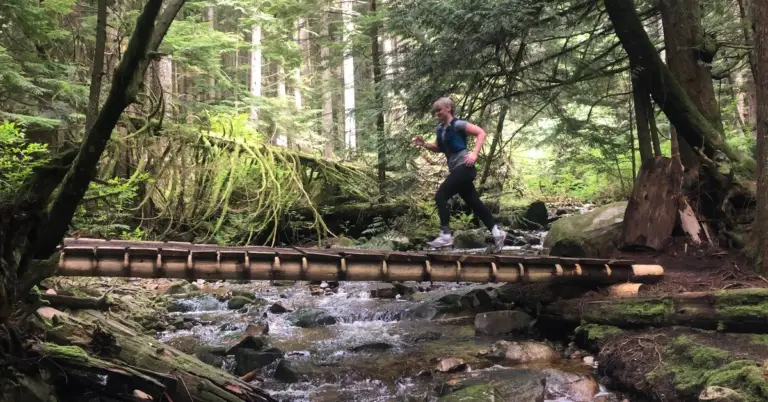
Trail running covers a huge range of terrain. A flat gravel path through a park and a steep mountain trail full of roots, rocks, mud, and switchbacks both count.
As terrain becomes more technical, your body has to respond to constant small changes underfoot. Your stride length changes, your foot placement varies, and you’re using more balance and coordination than you would on a predictable road surface.
Hills add another layer. Uphill running has a higher cardiovascular and energy cost, while downhill running places greater eccentric demand on the muscles as they work to control your descent. That’s one reason your quads may have some opinions about your first hilly trail run the following day.
Start With Easier Trails
Your first trail run doesn’t need to involve a mountain. If you’re comfortable running on the road, start with relatively flat, non-technical trails where the surface is predictable and you can focus on getting used to running off pavement.
Around Vancouver and the Lower Mainland, areas such as Pacific Spirit Regional Park, Burnaby Lake, and some of the trails around Sasamat Lake can be good places to start, depending on the route you choose. As you get more comfortable, you can gradually add elevation and more technical terrain.
I’d also make your first few trail runs shorter than an equivalent road run. Five kilometres on a hilly, technical trail can require considerably more time and muscular effort than five kilometres on pavement, so distance alone isn’t a great way to compare the workload.
Do You Need Trail Running Shoes?
If you’re starting on flat gravel or smooth, well-maintained trails, your regular road shoes are usually fine. Trail shoes become more helpful as the terrain gets steeper, wetter, looser, or more technical. They generally have deeper lugs for traction and uppers designed to provide more protection and security around the foot.
You don’t need the most aggressive mountain shoe you can find for a gentle local trail. Match the shoe to the terrain you’re actually running on.
If you’re heading onto wet roots, slippery rocks, mud, or steep descents, grip becomes much more important. Comfort still counts too; a trail shoe that theoretically has the perfect features isn’t much help if your feet hate being in it.
Forget Your Road Pace
One of the biggest adjustments for me was getting used to how much trail pace can vary. Your trail pace will usually be slower than your road pace, sometimes dramatically slower; and that’s okay! I was initially so disappointed as according to my pace I had “gotten so slow”, but I was trying to compare it to a flat road. Elevation, technical terrain, weather, surface conditions, and how confident you feel descending can all change how quickly you cover a kilometre.
Trying to force your normal easy road pace up a hill is also a great way to accidentally turn an easy run into a hard workout.
This is where RPE, or rating of perceived exertion, becomes particularly handy. If the goal is an easy run, aim to keep the effort easy even when your pace changes from one section of trail to the next.
If you want a deeper explanation of using effort alongside pace and heart rate, read my guide RPE for Running: How to Use Effort, Heart Rate, and Pace Together.
Walking Is Part of Trail Running
Yes, you’re allowed to walk. We call it power hiking though, because that sounds much more impressive.
Walking steep climbs is completely normal in trail running, including in races. On a steep enough hill, hiking can be more efficient than trying to maintain a running motion at essentially the same speed.
You may also choose to walk a steep or technical descent while you’re building confidence. There’s no prize for launching yourself down a rocky hill faster than your current skill level allows.
Over time, you’ll work out where running feels comfortable and where hiking makes more sense.
Be Patient With Downhill Running
New trail runners often expect the uphill to be the difficult part, then discover that descending can be surprisingly demanding.
Running downhill requires your muscles, particularly your quads, to repeatedly absorb and control force. Research on graded running shows that downhill running creates substantial eccentric muscular demands, which can contribute to fatigue and soreness.
You also have to make constant decisions about foot placement. Keep your steps relatively short, look ahead at the trail rather than directly at your feet, and give yourself permission to slow down while you learn. Technical downhill running is a skill, so give yourself time to get comfortable with it.
Trail Running Safety Requires a Little More Planning
Road runs often keep you close to houses, roads, water fountains, and cell service. Trails can take you away from all of those pretty quickly.
Before you go, tell someone where you’re running, which route you’re planning to take, and approximately when you expect to be back. I do this even when I’m running with someone else if we’re heading somewhere remote.
Live location features such as Garmin LiveTrack and Strava Beacon can also be helpful when you have cellular coverage. Though they shouldn’t be your only safety plan because location updates may stop when you lose service. If youre somewhere really remote, I recommend a GPS device such as a Garmin InReach.
Check your route before leaving and download the map for offline use. Trailforks, Gaia GPS, AllTrails, and Strava are some of the options available for route planning and navigation. If you’re heading somewhere unfamiliar, knowing the major junctions and your planned turnaround point before you start makes life much easier.
Also check the weather, daylight, and trail conditions. Mountain weather can change quickly, and trails that are straightforward in dry conditions can feel very different when they’re wet, snowy, or icy.
Carry Fuel and Water Based on Time, Not Distance
This is an easy mistake to make when you come from road running. If you normally know how much fuel and water you need for a 10 km road run, don’t automatically pack the same amount for a 10 km trail run. The trail version could take considerably longer depending on the elevation and terrain.
Plan around how long you expect to be out and give yourself some margin in case the run takes longer than planned.
A running vest can make carrying water, fuel, your phone, a light layer, and basic safety gear much easier once your runs get longer or more remote.
Trail Running Adds Different Demands to Your Body
Uneven terrain, hills, and descents increase the demands on balance, coordination, and strength.
Research on trail running injuries shows that lower-limb injuries are the most common, with the ankle among the areas frequently affected. Ankle sprains are also one of the more common acute injuries reported in trail runners.
Strength work that develops your calves, quads, hamstrings, hips, and overall lower-limb control can support the demands of climbing, descending, and navigating uneven ground. Balance and single leg exercises are also particularly relevant when the surface beneath you isn’t predictable.
If strength training is something you’ve been meaning to add, my post on Strength Training for Runners is a good place to start.
What Should You Bring on Your First Trail Run?
For a short run on an easy local trail, you don’t need a backpack full of expedition gear. What you carry should match the route, conditions, and how remote you’ll be.
For most beginner trail runs, consider:
- Your phone
- A downloaded map or route
- Water if you’ll be out long enough to need it
- Fuel for longer runs
- An extra layer if weather conditions could change
- Sunscreen and sun protection
- A small first-aid kit for longer or more remote outings
- A headlamp if there’s any chance you’ll be out near dusk
The farther you get from roads, cell service, and other people, the more self-sufficient you need to be. And one thing I want to make super duper clear – do not rely on your cell phone for a light source. If the conditions change and you’re out later than intended, you don’t want to drain your battery using the flashlight.
How Quickly Should You Progress Your Trail Running?
Treat trail running as a new training stimulus, even if you’re already a strong road runner. You might have plenty of cardiovascular fitness to run for two hours, but your calves, ankles, quads, and feet may not yet be accustomed to two hours of climbing, descending, and uneven terrain.
Start with manageable routes and see how your body responds during the run and over the following day or two. Then gradually add distance, elevation, or technical difficulty rather than increasing everything at once.
That gradual progression also gives you time to develop the skills that make trail running feel smoother and more relaxed.
The Bottom Line on Trail Running for Beginners
You don’t need fancy gear, mountain-running experience, or a certain pace to start trail running. Choose an approachable trail, slow down, hike when you need to, carry enough fuel and water for the time you’ll be out, and make sure someone knows where you’re going.
Most importantly, enjoy being outside! One of the best things about trail running is that it gives you permission to stop staring at your pace and pay attention to where you actually are.
Key Takeaways
- Start on relatively flat, non-technical trails before progressing to steeper or more technical terrain.
- Road shoes can work well on smooth trails, while trail shoes become more helpful when you need additional grip and protection.
- Trail pace is usually slower than road pace, so use effort rather than pace to guide many of your runs.
- Walking steep climbs is completely normal in trail running.
- Downhill running places substantial eccentric demand on the legs and takes practice.
- Tell someone your route and expected return time, and download your map before heading out.
- Plan fuel and hydration around the time you expect to be running rather than distance alone.
- Strength, balance, and single-leg control can help prepare you for uneven terrain and hills.
- Increase trail distance, elevation, and technical difficulty gradually rather than all at once.
Want to Feel Stronger on the Trails?
Trail running asks a lot from your legs, especially when you start adding hills, technical terrain, and longer descents.
My running-specific strength programs are designed to help runners build the strength and capacity they need for running without turning strength training into another full-time job.
→Explore running strength programs
Frequently Asked Questions About Trail Running for Beginners
Hard is subjective, but trail running can feel harder than road running because hills, uneven terrain, and changes in footing increase both the cardiovascular and muscular demands. Pace is usually slower, so comparing trail pace directly with road pace isn’t particularly helpful.
You can use road shoes on smooth, non-technical trails. Trail shoes become more helpful on muddy, rocky, steep, or slippery terrain because they generally provide more grip and protection.
Absolutely. Hiking steep climbs is completely normal in trail running, including during races. Walking can also be the sensible choice on technical descents while you’re developing confidence and skill.
There isn’t one ideal distance. Start shorter than your usual road run because elevation and technical terrain can substantially increase the time and effort required. Progress once you know how your body responds.
Elevation, uneven terrain, corners, roots, rocks, mud, and technical descents all reduce running speed. Trail running is generally better judged by effort and time than by comparing kilometre pace with your road running.
For a short local run, your phone, route map, appropriate clothing, and water when needed may be enough. Longer or more remote runs usually require additional fuel, water, layers, navigation, and basic safety equipment.
Trail running places different muscular demands on the legs because of hills and uneven terrain, but it doesn’t replace progressive strength training. Dedicated strength work can help develop the force, control, and capacity required for climbing, descending, and technical terrain.
References
Lu, Z., Suo, B., Deng, L., Wang, J., Fu, W., Zhong, Y., & Jin, J. (2025). A review of uphill and downhill running: biomechanics, physiology and modulating factors. Frontiers in bioengineering and biotechnology, 13, 1690023. https://doi.org/10.3389/fbioe.2025.1690023
Viljoen, C., Janse van Rensburg, D. C. C., van Mechelen, W., Verhagen, E., Silva, B., Scheer, V., Besomi, M., Gajardo-Burgos, R., Matos, S., Schoeman, M., Jansen van Rensburg, A., van Dyk, N., Scheepers, S., & Botha, T. (2022). Trail running injury risk factors: a living systematic review. British journal of sports medicine, 56(10), 577–587. https://doi.org/10.1136/bjsports-2021-104858
Vincent, H. K., Brownstein, M., & Vincent, K. R. (2022). Injury Prevention, Safe Training Techniques, Rehabilitation, and Return to Sport in Trail Runners. Arthroscopy, sports medicine, and rehabilitation, 4(1), e151–e162. https://doi.org/10.1016/j.asmr.2021.09.032