If you’re in perimenopause or postmenopause and feel like the same eating and training habits aren’t giving you the same results they used to, “my metabolism has slowed down” is a pretty reasonable place for your brain to go. And maybe something has changed. The relationship between menopause and metabolism is more complicated than your hormones suddenly flipping a switch. Age, body composition, activity levels, sleep, medications, energy intake, and other health factors can all affect how much energy your body uses.
So rather than assuming your metabolism has slowed down, it helps to get a little more specific about what we actually mean by “metabolism”, and what we can measure.
Quick terminology note before we get into it. Menopause itself is a point in time, confirmed retrospectively after 12 consecutive months without a menstrual period. The years leading up to that point are perimenopause, and the years afterwards are postmenopause. I’ll talk about both throughout this article.
Does menopause slow your metabolism?
This is one of those questions where the most accurate answer is: it depends what part of metabolism we’re talking about.
Resting metabolic rate, or RMR, is the amount of energy your body uses at rest to keep basic physiological processes running. Think breathing, circulation, brain function, temperature regulation, cell repair, and all the other things happening while you’re doing absolutely nothing exciting.
Your total daily energy expenditure includes RMR plus the energy you use for exercise, general daily movement and digestion. Research suggests resting energy expenditure tends to decline with age. Whether menopause itself causes an additional drop, independent of ageing, body composition and lifestyle, is less clear.
For example, a 2023 study that measured resting energy expenditure using indirect calorimetry found that age was associated with lower adjusted resting energy expenditure, while menopausal status wasn’t.
A 2026 study comparing premenopausal, perimenopausal and postmenopausal women also found no significant differences in resting energy expenditure when body composition and movement behaviours were comparable between groups.
So despite what social media influencers tell you, there doesn’t appear to be one inevitable metabolic cliff that everyone falls off when they reach menopause!
Your body composition can still change
This is where things get interesting. Even if your resting metabolism hasn’t dramatically dropped, body composition can change across the menopause transition.
Research from the Study of Women’s Health Across the Nation found that the rate of fat gain increased during the menopause transition while lean mass began to decline. Interestingly, body weight itself didn’t suddenly accelerate at the start of the transition
That means two things can be true at once. Your weight might look relatively similar, while the amount and distribution of fat and lean tissue are changing. Lean tissue contributes to resting energy expenditure, so changes in body composition are one of the factors that can influence resting energy expenditure.
Daily movement can change during this stage of life too. Previous longitudinal research has found reductions in physical activity energy expenditure during the menopause transition, which can lower total daily energy expenditure even when resting metabolism itself hasn’t changed very much.
Add in disrupted sleep, changes in training, injuries, stress, appetite, and the general chaos that can come with this stage of life, and it becomes pretty easy to see why “I feel like my metabolism has changed” can be a difficult question to answer with one simple explanation.
This is also where strength training is important
Loss of lean mass is part of ageing, which makes maintaining muscle increasingly important as we get older.
Strength training is one of the most effective tools we have for preserving and building muscle, while also supporting strength, bone health, and physical function.
If you’re already running regularly, adding appropriate strength training becomes even more valuable because running alone doesn’t provide the same stimulus for maintaining muscle and strength. Running is weight-bearing, but repetitive weight-bearing alone is not the same as deliberately training for bone adaptation, which is especially important during the menopause transition.
So what does an RMR test actually tell you?
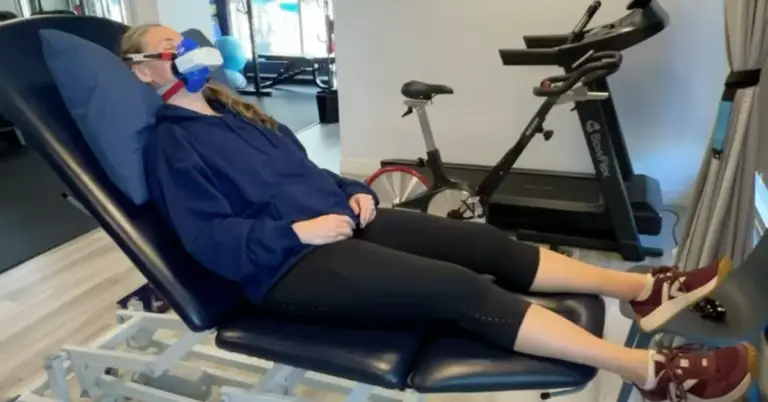
A Resting Metabolic Rate test measures how much energy your body uses while you’re resting.
Rather than estimating that number from your age, height and weight, the mask measures the oxygen you consume and minute ventilation while you rest. From that respiratory data, we can calculate your resting energy expenditure.
That gives us an individualized measurement to use as a starting point when looking at your overall energy needs.
Your RMR still isn’t the number of calories you should automatically eat each day. Exercise, general movement, digestion and your individual goals all contribute to total daily energy requirements. But knowing your measured RMR removes one of the estimates from that equation.
If you want a deeper explanation of how testing works, I’ve also written a full guide to what resting metabolic rate testing measures.
Why an online calculator might miss the mark in perimenopause
Online calorie calculators aren’t useless. They use prediction equations developed from population data and can provide a reasonable estimate for plenty of people. But the important word there is estimate.
A 2026 study looked specifically at this in 45 perimenopausal women. Researchers measured resting energy expenditure using indirect calorimetry, then compared those results with six commonly used prediction equations.
Four of the six equations significantly overestimated measured resting energy expenditure. Across the equations, estimated values were about 215 calories per day higher on average than the measured results.
That doesn’t mean every online calculator overestimates a perimenopausal woman’s metabolism by exactly 215 calories. Two of the equations studied, Mifflin St Jeor and Molnar, were much closer to the measured values. But it does show why an estimate and a measurement aren’t interchangeable.
If you’re interested in the difference, I break this down further in my article on RMR testing versus calorie calculators.
What an RMR test can and can’t tell you
An RMR test gives you one useful piece of the bigger picture.
It can:
- Measure how much energy your body is using at rest.
- Give you a more individualized starting point for estimating total daily energy needs.
- Help inform fuelling or body composition goals.
- Provide baseline data that can be reassessed later.
It can’t diagnose why your weight has changed, tell us that menopause is responsible for a change in your metabolism, or give you one perfect calorie number that automatically accounts for your entire life.
If you’re experiencing unexplained or rapid changes in weight, significant fatigue or other symptoms that could indicate an underlying medical issue, RMR testing also isn’t a replacement for appropriate medical assessment.
Who might find RMR testing useful during perimenopause or postmenopause?
You don’t need an RMR test simply because you’ve reached a certain age. It can be useful if you genuinely want better information about your own energy needs.
Maybe you’ve been using an online calculator for years and the numbers no longer seem to fit. Perhaps your training, body composition or goals have changed. Or maybe you keep saying, “I swear my metabolism has slowed down,” and you’d like to know what your resting metabolism is actually doing.
That last one is a perfectly reasonable reason to test it.
Key Takeaways
- Resting metabolic rate is the energy your body uses to maintain basic physiological functions at rest.
- Resting energy expenditure tends to decline with age, but current research doesn’t show a consistent independent drop caused by menopausal status alone.
- Body composition can change across the menopause transition, including increased fat mass and reduced lean mass.
- Running is weight-bearing, but repetitive weight-bearing alone is not the same as deliberately training for bone adaptation.
- Strength training can help preserve muscle and strength, while also providing an important stimulus for bone health through perimenopause and postmenopause.
- RMR testing uses indirect calorimetry to measure your resting energy expenditure rather than estimating it from a prediction equation.
- Online calorie calculators can provide a reasonable estimate for some people, but their accuracy varies considerably between individuals.
- Your RMR is only one part of your total daily energy requirements and isn’t automatically the number of calories you should eat each day.
Feel like your metabolism has slowed down? Let’s actually measure it.
There are plenty of changes happening during perimenopause and postmenopause that we can’t reduce to one number.
Your resting metabolic rate happens to be one that we can measure.
RMR testing at Morgan Exercise Physiology in Port Moody uses indirect calorimetry to measure your resting energy expenditure and gives you individualized information to help guide your nutrition, training, and body composition goals.
If you’re curious about what your metabolism is actually doing, you can learn more about Resting Metabolic Rate testing or book a test at the clinic.
Frequently Asked Questions About Menopause and Metabolism
Resting energy expenditure tends to decline with age, but current research doesn’t show a consistent independent drop caused by menopausal status alone. Changes in body composition, activity, and other lifestyle and health factors can all contribute to changes in energy expenditure.
Body composition commonly changes across the menopause transition, including increases in fat mass and reductions in lean mass. Research suggests the relationship with body weight itself is more complex, and weight gain shouldn’t automatically be attributed to menopause alone.
An RMR test measures how much energy your body uses while resting. Indirect calorimetry uses respiratory measurements to calculate your resting energy expenditure.
No. Your RMR represents the energy your body uses at rest. Your total daily energy requirements also include exercise, general movement, digestion and other activity. RMR provides a measured baseline that can then be used as part of estimating your overall energy needs.
Their accuracy varies. A 2026 study in perimenopausal women found that four of six commonly used prediction equations significantly overestimated measured resting energy expenditure, while two equations were much closer. Online calculators can provide a reasonable starting estimate, but indirect calorimetry measures your resting energy expenditure rather than predicting it from population data.
References
Bonnes, S. L. R., Nordhues, H., Sood, R., Kulick, D., Muratore, A., & Bischof, E. (2026). Metabolic Changes of Perimenopause and Nutritional Advice. Current nutrition reports, 15(1), 69. https://doi.org/10.1007/s13668-026-00788-8
DelBiondo, G. M., Moore, S. R., Baker, P. A., Ladan, A. N., Britton, M. E., & Smith-Ryan, A. E. (2026). Resting Energy Expenditure is Overpredicted in Midlife Females: Examining the Accuracy of Predictive Equations and the Role of Lean Soft Tissue in Perimenopause. Journal of the American Nutrition Association, 45(6), 572–578. https://doi.org/10.1080/27697061.2026.2658497
Greendale, G. A., Sternfeld, B., Huang, M., Han, W., Karvonen-Gutierrez, C., Ruppert, K., Cauley, J. A., Finkelstein, J. S., Jiang, S. F., & Karlamangla, A. S. (2019). Changes in body composition and weight during the menopause transition. JCI insight, 4(5), e124865. https://doi.org/10.1172/jci.insight.124865
Karppinen, J. E., Wiklund, P., Ihalainen, J. K., Juppi, H. K., Isola, V., Hyvärinen, M., Ahokas, E. K., Kujala, U. M., Laukkanen, J., Hulmi, J. J., Ahtiainen, J. P., Cheng, S., & Laakkonen, E. K. (2023). Age But Not Menopausal Status Is Linked to Lower Resting Energy Expenditure. The Journal of clinical endocrinology and metabolism, 108(11), 2789–2797. https://doi.org/10.1210/clinem/dgad321
Marcantei, C., Metz, L., Ramos, I., Pereira, B., Dutheil, F., De Saint Vincent, S., Duclos, M., & Isacco, L. (2026). Energy metabolism in resting and postprandial states might not be influenced by menopausal stage in women. Nutrition, metabolism, and cardiovascular diseases : NMCD, 36(7), 104637. https://doi.org/10.1016/j.numecd.2026.104637
Zhao, F., Su, W., Sun, Y., Wang, J., Lu, B., & Yun, H. (2025). Optimal resistance training parameters for improving bone mineral density in postmenopausal women: a systematic review and meta-analysis. Journal of orthopaedic surgery and research, 20(1), 523. https://doi.org/10.1186/s13018-025-05890-1