Booking a VO₂ max test can feel a little intimidating if you’ve never done one before. You know there’s a mask involved, you know you’ll eventually be working hard, and you may be wondering exactly what happens between walking through the door and getting your results.
The actual testing process is fairly straightforward. You’ll start at a manageable intensity while I measure your breathing, oxygen consumption, heart rate, and response to exercise. The workload gradually increases until you reach your maximum effort, then we’ll spend time going through what the data means for your training.
Here’s what to expect during a VO₂ max test at my clinic in Port Moody.
Before Your VO₂ Max Test
You want to arrive ready to exercise hard enough to get meaningful results, so treat the test similarly to an important workout.
Avoid heavy training and alcohol for the 24 hours beforehand. Avoid heavy meals and caffeine for about three hours before your appointment, and arrive well hydrated. Bring the shoes and clothing you normally use for your sport. If you’re running, wear your regular running shoes, if you’re cycling, my bike can accommodate regular shoes and those with SPD clips.
Your appointment begins with a conversation about your training, goals, and exercise history. That information helps me choose an appropriate testing protocol rather than putting everyone through exactly the same speeds or workloads.
Setting Up the VO₂ Master
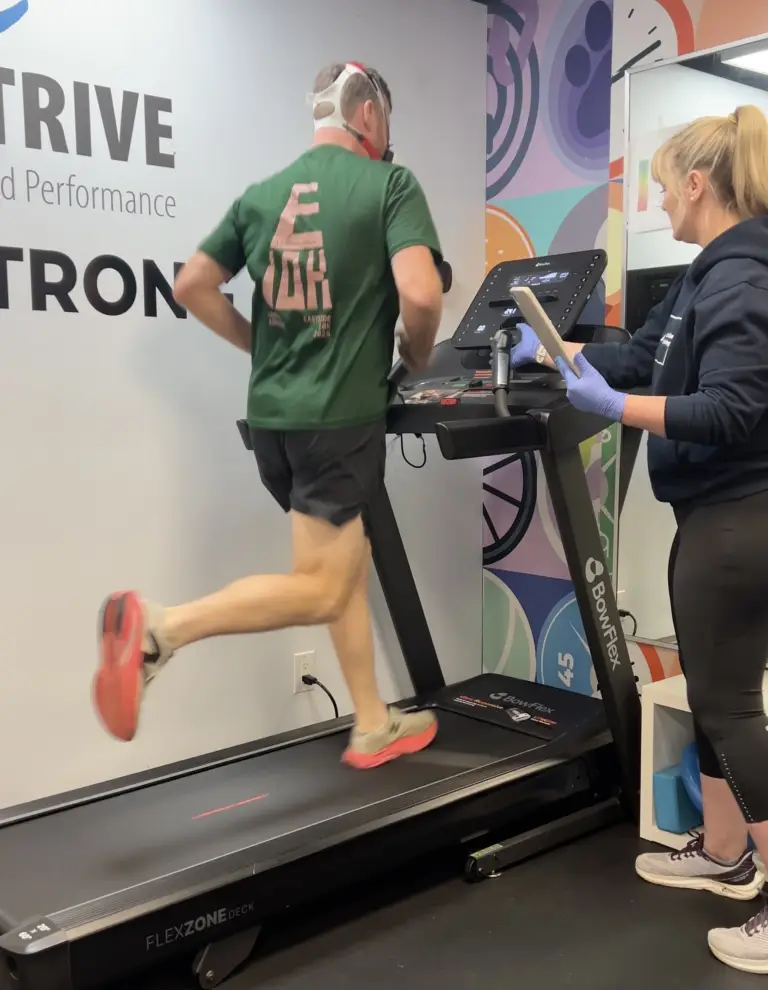
You’ll wear a mask attached to the VO₂ Master, which measures your oxygen consumption and ventilation while you exercise.
There isn’t a long hose connecting you to a stationary metabolic cart, so you can move naturally on the treadmill or bike.
The mask needs to fit securely so we get good respiratory data. It can feel a little unfamiliar at first, which is why you’ll have time to get comfortable with it before the test gets hard.
You’ll also be wearing a chest strap that allows me to monitor your heart rate throughout the test so we can see how your cardiovascular response lines up with your breathing, pace, or power.
Your Test Starts With a Warm-Up
Don’t worry, you won’t put the mask on and immediately start sprinting.
We’ll begin with a 10 minute warm-up and make sure you’re comfortable on the treadmill or bike. The initial workload is deliberately manageable because we need data across a range of exercise intensities before you reach your maximum effort.
I’d always recommend a warm-up before a maximal effort, whether you’re testing, training, or racing. A progressive warm-up allows your heart rate and systolic blood pressure to rise gradually, increases blood flow to your working muscles, and raises muscle temperature. It also gives you time to mentally prepare for the effort ahead, so you’re both physiologically and psychologically ready to work hard.
The starting point is individualized. Someone newer to running will start differently from an experienced marathon runner. The same goes for cyclists.
How the VO₂ Max Test Progresses
Once the test begins, the workload increases in stages.
For most runners, I generally keep the treadmill flat and increase speed every minute. This gives us heart-rate and pace information that is easy to apply back to your running. Your starting speed and progression are based on your current ability, so there isn’t one treadmill protocol that every runner has to follow.
If your sport or goal requires something different, the protocol can change. For example, an uphill-focused test may progress through increasing incline rather than speed.
Cyclists can complete their test using the Garmin Tacx Neo. In that case, the workload increases in watts while you maintain a consistent cycling cadence, allowing us to establish heart-rate and power zones from the test.
What Is the VO₂ Master Measuring?
As the workload increases, the VO₂ Master measures how much oxygen you’re consuming and how your breathing responds.
The system measures variables including:
- VO₂, or oxygen consumption
- Ventilation, which is the total volume of air you breathe each minute
- Tidal volume, or how much air you move with each breath
- Breathing frequency
- The percentage of oxygen in your expired air
- Heart rate when paired with the heart-rate sensor
Looking at how these variables change as exercise gets harder allows us to identify your VO₂ max and ventilatory thresholds.If you want the deeper physiology behind those numbers, I cover it in What Does a VO₂ Max Test Tell Me?
H2: How Hard Does a VO₂ Max Test Feel?
The beginning should feel very manageable. The middle gradually becomes more challenging, and the final stages are hard.
A true maximal test will suck, I’m not going to sugar coat it. It requires you to reach a very high level of effort, so you can expect your breathing to become heavy and your legs to feel the increasing workload near the end. But we get the most accurate data from a true maximal effort, so I will encourage you to keep going as long as you can.
The hard part is relatively short though. The exercise portion of the test is usually around 8 to 12 minutes, depending on the protocol and the individual.
You’re supervised throughout, and I’m watching both your physiological data and how you’re responding to the test. When you reach your limit, the test stops and you move into your cooldown.
Do You Have to Be a Fast Runner to Do a VO₂ Max Test?
Nope. The protocol is built around your current fitness and exercise ability. You don’t need to hit a particular pace, VO₂max score, or race standard to be able to complete a test.
Testing can be equally valuable for someone who is relatively new to endurance training and wants to establish appropriate training intensities. Your results provide a starting point for your training and a baseline against which we can measure future progress.
All clients are required to complete a Physical Activity Readiness Questionnaire (PAR-Q) and waiver before testing. Depending on your medical history or any symptoms identified during screening, medical clearance may be required before testing can proceed.
What Happens After Your VO₂ Max Test?
After your cooldown, we’ll discuss your results.
Your results include:
- VO₂ max
- Maximum heart rate achieved during testing
- Ventilatory thresholds
- Personalized heart-rate training zones
- Speed zones for runners or power zones for cyclists
- Breathing and ventilation data
I’ll explain what your results mean in the context of your current training and goals. For example, if you’ve been struggling to work out how easy your easy runs should feel, we can look at the heart rates and running speeds associated with your first ventilatory threshold.
You’ll also receive a detailed report by email so you can refer back to your results when planning your training.
How Do You Apply Your VO₂ Max Test Results to Your Training?
Having individualized training zones can help you better understand the intensities at which you should be completing different types of workouts, from easy endurance sessions through to threshold training and harder intervals.
You can use your test results to update the heart-rate zones on your Garmin or other compatible sports watch, replacing the default zones with ones based on your measured physiological response. You can also use your new pace or power zones to set more appropriate targets for structured workouts.
This can be particularly helpful if you’ve been struggling to keep your easy runs easy, questioning the accuracy of your existing training zones, or unsure what intensity to aim for during threshold sessions.
Your heart rate and pace will still be influenced by factors such as heat, hills, accumulated fatigue, and hydration. Use your zones alongside RPE, your training goals, terrain, environmental conditions, and how you’re recovering.
If you’re unfamiliar with heart-rate training or unsure how to incorporate your new zones into your running program, I cover this in Heart Rate Training Basics for Runners.
How Long Does a VO₂ Max Testing Appointment Take?
Allow 60 minutes for your appointment. Although the graded exercise portion usually takes around 8 to 12 minutes, the rest of the appointment includes our initial discussion, equipment setup and calibration, warm-up, cooldown, and results interpretation.
Key Takeaways
- Prepare for your VO₂ max test similarly to an important workout or race. Arrive rested and well hydrated.
- Testing protocols are individualized according to your fitness, exercise background, and goals.
- Testing can be performed on a treadmill or bike.
- The exercise portion generally lasts around 8 to 12 minutes excluding warm up and cool down, with the workload gradually increasing towards maximum effort.
- Your full appointment takes approximately 60 minutes, including time to discuss your results.
- Your results include VO₂ max, maximum heart rate achieved, ventilatory thresholds, breathing data, and personalized training zones.
- You’ll receive a detailed report by email following your appointment.
Ready to Book Your VO₂ Max Test?
If you want to better understand your cardiovascular fitness and establish training zones based on your own physiology, I offer VO₂ max testing at my clinic in Port Moody, BC.
Your appointment includes individualized testing, a detailed report, and one-on-one interpretation of your results with a Clinical Exercise Physiologist.
Learn more about VO₂ max testing and book your appointment here.
Frequently Asked Questions About VO₂ Max Testing
The graded exercise portion usually lasts around 8 to 12 minutes, depending on the individual and testing protocol. Your full appointment takes approximately 60 minutes, including preparation, warm-up, cooldown, and results interpretation.
Avoid heavy training and alcohol for 24 hours before your appointment, and avoid heavy meals and caffeine for approximately three hours beforehand. Arrive well hydrated and bring appropriate exercise clothing and footwear.
No. You want to arrive adequately fuelled for exercise, although you should avoid heavy meals for approximately three hours before your appointment.
No. Testing can be performed using a running, incline walking, or cycling protocol, depending on your current fitness, exercise background, and goals.
The test begins at a manageable intensity and becomes progressively harder. A maximal test requires a high level of effort during the final stages, although you only spend a short period exercising at those higher intensities.
Testing protocols can be adapted to different fitness levels. You don’t need to reach a particular running speed or fitness standard before booking a test. And in fact it’s a great way to measure baseline fitness before starting an exercise program.
Yes. Your ventilatory thresholds and heart-rate response are used to establish personalized heart-rate training zones. Runners also receive pace zones, and cyclists receive power zones.
We’ll discuss your results during your appointment, and you’ll receive a detailed report by email.
References
VO₂ Master. (n.d.). VO₂ Master Analyzer user manual. https://vo2master.com/user-manual/