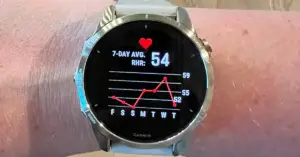
If you wear a running watch, you probably see your resting heart rate every morning. It can be an interesting number to follow, especially when you’re training consistently and start to recognise your usual range.
For runners, resting heart rate can provide information about cardiovascular fitness and how the body is responding to training, sleep, illness and other stressors. Its value comes from following your own pattern over time, not comparing it to other runners’ numbers. A resting heart rate of 48 beats per minute may be completely normal for one runner, while another runner may sit closer to 65bpm.
Changes from your usual range is where the data can be really informative. If your resting heart rate normally hovers around 50 bpm and starts sitting closer to 58 or 60bpm for several mornings, it’s worth considering what has been happening with your training, recovery, sleep, and general health.
What Is Resting Heart Rate?
Resting heart rate, or RHR, is the number of times your heart beats per minute when you’re calm and physically at rest. For most adults, 60 to 100bpm falls within the typical clinical range, although physically active people are often around the lower end.
Endurance training produces cardiovascular adaptations that can reduce resting heart rate. As the heart gets stronger, it becomes capable of pumping more blood with each beat, and fewer beats may be required to maintain circulation at rest. Essentially, your heart has become more efficient. Well-trained endurance athletes may therefore have resting heart rates in the 40s.
A low resting heart rate also needs to be considered in context. Age, sex, genetics, medications, training history, and individual physiology can all influence the number you see. Two runners with similar fitness and race performances can have quite different resting heart rates.
What Is a Normal Resting Heart Rate for a Runner?
There is no single resting heart rate that runners should aim for, as mentioned above it can be largely individual. For a ballpark – recreational runners commonly record values in the 50s or 60s, while highly trained endurance athletes may regularly see numbers in the 40s.
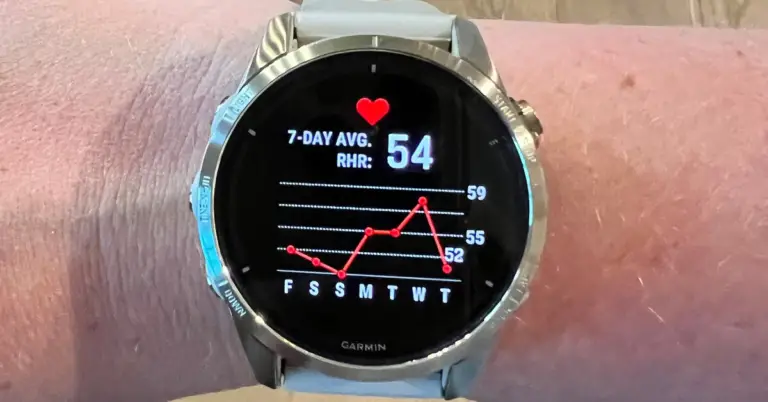
Your own history gives the number more meaning. After wearing the same device consistently for several weeks, you will usually begin to recognise a fairly predictable range. Someone who normally sits between 48 and 52 bpm may notice a change when several mornings appear in the high 50s. For a runner whose usual range is 56 to 62 bpm, the same reading would be routine.
This is also why comparing resting heart rate with friends or other runners online has limited value. Their training history, genetics, health, medications, and physiology may be completely different from yours.
Why Does Resting Heart Rate Change?
Resting heart rate responds to many of the demands placed on your body, so some variation from day to day is expected. Sleep, illness, psychological stress, recent training, hydration, heat, and alcohol can all contribute.
Looking at what has happened over the previous few days can help explain an unexpected reading. Changes that persist and occur alongside other signs of poor recovery generally deserve closer attention.
Sleep
Short or disrupted sleep can influence cardiovascular function. Research using smartwatch data has found higher resting heart rates among people averaging six hours of sleep or less compared with those sleeping longer.
For a runner balancing training with work, family, and social commitments, that connection is important to keep in mind. A higher reading after a bad night of sleep may fit with the extra stress your body has experienced. Several poor nights combined with heavy legs, higher perceived effort and worsening fatigue tells you that you may not be recovering well.
Illness
Resting heart rate may rise when your body is dealing with an infection. Research using commercial wearables has found increases in resting heart rate during influenza-like illness, with changes sometimes appearing before participants reported symptoms.
Wearable data can therefore provide another signal to pay attention to when you also feel unusually tired, achy, feverish or unwell. A rising resting heart rate alongside developing symptoms may support the decision to reduce training intensity or take a rest day.
Stress
Psychological stress can affect heart rate through changes in autonomic nervous system activity. Deadlines, family responsibilities, poor sleep, and emotional stress all add to the demands your body is managing alongside your running.
This can help explain why recovery sometimes feels poor even during a lighter training week. Training load may have decreased while demands elsewhere in your life have increased. Your morning heart-rate data may reflect some of that accumulated strain.
Training Load
Hard training can temporarily change resting heart rate. A race, long run, demanding interval session, or high-volume training block creates physiological stress and requires recovery afterward.
Responses vary considerably between runners, so there’s not one hard and fast rule. But a sustained increase in your resting heart rate is worth paying attention to when it appears alongside poor sleep, declining motivation, unusually heavy legs, or easy runs that suddenly require more effort.
Hydration, Heat, and Alcohol
Long runs in hot weather, heavy sweating, and inadequate fluid replacement can affect cardiovascular function. These factors are particularly relevant during summer training or after races and long runs where fluid losses may be higher than usual.
Alcohol can also influence overnight heart rate. A 2025 study using smartwatch data found that moderate alcohol intake temporarily increased nocturnal resting heart rate in healthy adults. If your morning numbers change after a couple of drinks the night before, alcohol may be the contributing factor.
How Much Attention Should You Pay to One High Reading?
A single elevated resting heart rate usually needs some context before you change your training. Imagine your usual resting heart rate is 50 bpm and you wake up to a reading of 57. Think back over the previous day or two and consider your sleep, recent workouts, heat exposure, hydration, alcohol intake, travel, life stress, and any early signs of illness.
Normal biological variation also occurs, and wearable measurements aren’t perfect. If your resting heart rate returns to its usual range the next morning and you feel well, there may be no reason to alter your training.
Several days of higher readings deserve more attention when you’re also noticing fatigue, poor sleep, reduced motivation or declining running performance. Following the trend allows you to see whether the change was brief or whether your normal pattern has genuinely shifted.
How Do Running Watches Measure Resting Heart Rate?
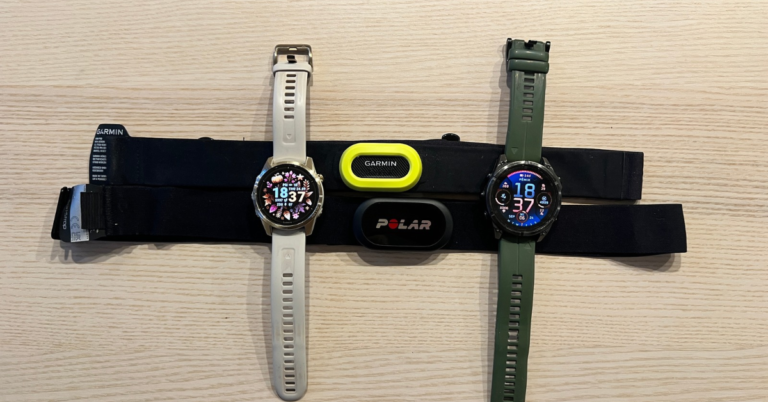
Running watches take an optical measurement using a light diode on the back of the watch, this is called photoplethysmography. This measures pulsatile blood flow through the skin by sensing the density of your red blood cells as they pass under the watch, then giving an estimated heart rate. It’s important to note here that the optical sensor is quite sensitive to movement and fit.
The resting heart rate shown on your running watch may differ from a pulse you manually count immediately after waking. Wearable companies collect and process heart-rate data differently, which can affect the number you see.
Garmin, for example, calculates daily resting heart rate using the lowest 30-minute average heart rate recorded within a 24-hour period. Garmin also recommends wearing the watch overnight to improve the accuracy of that estimate.
Apple Watch collects background heart-rate measurements throughout the day and overnight when sleep tracking is enabled. Apple uses those measurements across several health metrics, including resting and overnight heart-rate data.
These differences are good to remember if you change watches. A Garmin resting heart rate and an Apple Watch resting heart rate may be based on different collections of data, so the values don’t need to match perfectly.
For tracking your own recovery and longer-term trends, consistency helps. Wearing the same device regularly and comparing its readings with your own previous data gives you the most useful reference.
Resting heart rate and maximum heart rate tell you different things about your physiology. If you’re trying to understand how HRmax affects your training zones, read Maximum Heart Rate for Runners: Why 220 Minus Age Can Be Wrong.
Should You Change Your Training When Resting Heart Rate Is High?
I wouldn’t recommend automatically cancelling a workout every time your resting heart rate rises by a specific number of beats. Individual responses vary too much for one universal cut off to guide every runner.
Consider the reading alongside your sleep, energy, recent training load, perceived effort, and any signs of illness. When your resting heart rate is somewhat elevated and you otherwise feel well, your planned training may still be appropriate. A continual increase combined with poor recovery, unusual fatigue, or developing illness gives you more reason to adjust.
Depending on the circumstances, you might:
- Change intervals to an easy run
- Shorten the planned session
- Take a recovery day
- Move a demanding workout later in the week
- Give more attention to sleep, food, and hydration
[If you’re new to heart rate training, check out Heart Rate Training Basics For Runners to understand how heart rate fits alongside pace and RPE]
When Should a Change in Resting Heart Rate Be Checked?
Low resting heart rates are common among endurance-trained runners, although symptoms and unexplained changes are important to note. Speak with a healthcare professional if your resting heart rate becomes persistently faster or slower than usual and you don’t know why, particularly when the change occurs alongside dizziness, fainting, unusual shortness of breath, chest pain, palpitations, unexplained weakness, or a significant reduction in exercise tolerance.
A resting heart rate that is consistently above 100 bpm should also be medically assessed. Sudden major changes accompanied by chest pain, fainting, significant shortness of breath or other severe symptoms require urgent medical care.
The Bottom Line on Resting Heart Rate for Runners
Resting heart rate is most informative when you know your usual range and follow how it changes over time. Endurance runners often have lower resting heart rates than the general adult population, and there is no target number that every runner needs to achieve.
Pay attention to trends and consider what else is happening with your sleep, training, stress, health, and perceived effort. A watch can provide useful physiological data, but that information works best alongside the feedback you’re getting from your body and your training.
Key Takeaways
- Resting heart rate is the number of times your heart beats per minute while you’re physically at rest.
- Most adults have a resting heart rate between approximately 60 and 100 bpm, while endurance-trained runners often record lower values.
- There is no ideal resting heart rate for every runner.
- Your usual range and longer-term trend provide useful context when a reading changes.
- Sleep, illness, stress, training load, hydration, heat, and alcohol can influence resting heart rate.
- One unusual reading rarely provides enough information to make a major training change.
- Consider resting heart rate alongside sleep, symptoms, perceived effort, recent training and general recovery.
- Consistent use of the same wearable makes trends easier to interpret.
- Persistent unexplained changes accompanied by concerning symptoms should be medically assessed.
Want Help Making Sense of Your Running Data?
Having heart rate data is one thing, but knowing how to apply it to your training is where it becomes really helpful.
A one-on-one consultation can help you review your current training, heart-rate data, exercise intensity, and recovery so you can make informed decisions about your running. Consultations can also include heart-rate zone prescriptions, running assessments, technique check-ins, exercise prescription, and program reviews. In clinic and virtual options are available.
You can also subscribe to my newsletter or follow me on Instagram for more evidence based tips for runners.
Frequently Asked Questions About Resting Heart Rate For Runners
There is no single normal resting heart rate for every runner. Most adults fall between approximately 60 and 100 bpm, while endurance-trained athletes commonly record lower values, including readings in the 40s. Your usual range, health and symptoms all provide context.
A resting heart rate around 50 bpm can be normal for an endurance-trained runner, particularly when it falls within that person’s usual range and there are no concerning symptoms.
Poor sleep, illness, psychological stress, demanding training, dehydration, heat, and alcohol can all contribute to a higher resting heart rate. Look at what’s been happening over the previous few days and whether you’re experiencing other changes in recovery or health.
One elevated reading doesn’t automatically require a day off. Consider how you feel, how you slept, your recent training load, symptoms of illness and how your running has been feeling. A sustained increase accompanied by poor recovery or illness may support reducing or postponing harder training.
Endurance training often lowers resting heart rate, but the number is also influenced by genetics, age, medications, and health. Fitness cannot be judged from resting heart rate alone.
Yes. Research using wearable data has found increases in resting heart rate during influenza-like illness. Heart-rate changes may provide additional information when they occur alongside fatigue, fever, body aches or other symptoms.
References
American Heart Association. (2024). All About Heart Rate https://www.heart.org/en/health-topics/high-blood-pressure/the-facts-about-high-blood-pressure/all-about-heart-rate-pulse
Darzi, A. E., Khoury, C. E., Massad, C. M., Atasi, M. M., Khalil, M. A., Menassa, Y., Chaarani, N., Lim, C., Feng, H., & Marrouche, N. F. (2026). Short Sleep Duration Measured by Smartwatch Is Associated With Elevated Resting Heart Rate and Reduced Nocturnal Oxygen Saturation: Insights From Heartbeat. Journal of cardiovascular electrophysiology, 37(7), 1514–1521. https://doi.org/10.1111/jce.70358
Hunter, V., Shapiro, A., Chawla, D., Drawnel, F., Ramirez, E., Phillips, E., Tadesse-Bell, S., Foschini, L., & Ukachukwu, V. (2023). Characterization of Influenza-Like Illness Burden Using Commercial Wearable Sensor Data and Patient-Reported Outcomes: Mixed Methods Cohort Study. Journal of medical Internet research, 25, e41050. https://doi.org/10.2196/41050
Strüven, A., Schlichtiger, J., Hoppe, J. M., Thiessen, I., Brunner, S., & Stremmel, C. (2025). The Impact of Alcohol on Sleep Physiology: A Prospective Observational Study on Nocturnal Resting Heart Rate Using Smartwatch Technology. Nutrients, 17(9), 1470. https://doi.org/10.3390/nu17091470