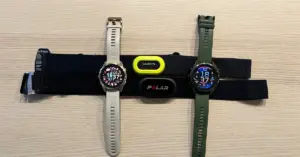
If you use heart rate to guide your running, your watch is probably giving you those numbers from a sensor on your wrist. For many runs, that’s convenient and often accurate enough, wrist-based monitors have come a long way after all.
Wrist-based heart rate monitoring is convenient and can work very well during steady running. Accuracy can become less reliable, though, when movement, fit, or rapid changes in intensity interfere with the optical signal.
You may see a sudden spike during an easy run, a strangely flat response during intervals, or a number that seems to follow your cadence more closely than your effort.
That’s usually when runners start wondering whether a chest strap would give them more reliable data.
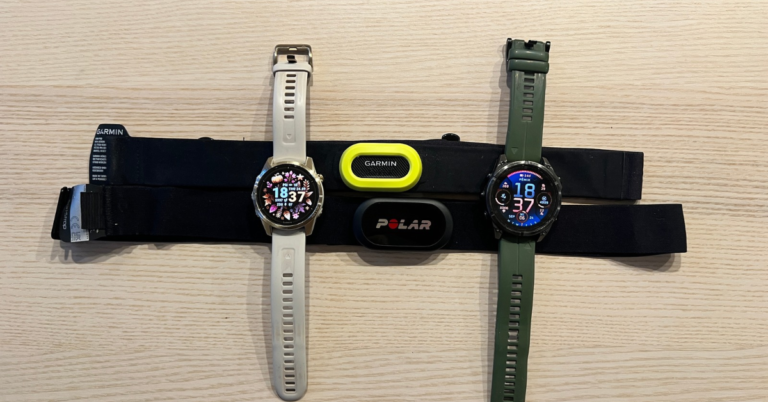
When comparing a chest strap vs wrist heart rate monitor for running, chest straps generally provide more dependable heart rate measurements during exercise, especially when heart rate is changing quickly. Wrist monitors can still work very well during steady running, so the best option depends on how precise you need the data to be.
How Does a Chest Strap Measure Heart Rate?
Most heart rate chest straps use electrodes that sit against the skin and detect the electrical activity associated with each heartbeat. The technology works on a similar principle to electrocardiography, although a consumer chest strap is much simpler than a clinical ECG and isn’t designed to diagnose heart conditions.
Because the strap detects the electrical signal from the chest, it can identify individual beats quickly and follow changes in heart rate closely. Research comparing chest straps with ECG has found strong agreement for heart rate measurements during exercise.
Chest straps can still produce errors though. Dry electrodes at the beginning of a run, poor positioning, a loose strap, or poor skin contact can interfere with the signal. Wetting the electrodes before you start and wearing the strap securely usually improves the connection.
How Does a Wrist Heart Rate Monitor Work?
Running watches typically measure heart rate using photoplethysmography, or PPG. Optical sensors on the back of the watch shine light into the skin and measure changes in reflected light as blood volume changes with each pulse. The watch then uses an algorithm to estimate your heart rate.
Wrist-based monitoring is convenient because the sensor is already built into your running watch. You can collect heart rate data during runs, daily activity, rest, and sleep without wearing another device.
Research suggests that wrist heart rate monitoring can perform well during steady exercise. A systematic review and meta-analysis of 44 studies across 15 wearable brands found a very small average difference between wrist PPG and reference heart rate measurements during treadmill walking and running.
That small average difference across the studies doesn’t mean every wrist-based reading will be accurate for every runner or every run. Device fit, movement, exercise intensity, skin contact, temperature, and the watch itself can all affect the quality of the reading.
If you also track your morning numbers, [Resting Heart Rate for Runners] explains how to interpret changes in your usual baseline.
Chest Strap vs Wrist Heart Rate Monitor: What’s the Practical Difference?
For steady easy and moderate running, a good wrist-based monitor may provide all the information you need. Chest straps become more useful when heart rate is changing rapidly or when accurate data will directly influence your training decisions.
Chest strap:
- Detects electrical activity associated with each heartbeat
- Responds quickly to changes in heart rate
- Is less affected by arm movement
- Requires an additional strap
- Is useful for intervals, physiological testing, and more precise heart rate training
Wrist heart-rate monitor:
- Uses optical PPG to estimate heart rate
- Is built into most modern running watches
- Often performs well during steady running
- Is more susceptible to movement and fit-related errors
- Is useful for everyday running and general heart rate trends
Why Can Wrist Heart Rate Be Wrong While Running?
Wrist heart rate monitors rely on a clean optical signal from the blood vessels beneath your skin. During running, that signal can be affected by movement, watch position and fit, changes in blood flow, skin characteristics, and anything that interferes with the light reaching the tissue beneath the sensor.
Watch Fit and Placement
Your watch needs consistent contact with your skin to get a reliable reading. If it’s loose enough to bounce or slide as your arm moves, small gaps can develop between the sensor and your wrist and interfere with the optical signal.
Wear the watch snugly above the wrist bone, where it can stay in contact with your skin throughout the run. It should be tight enough that it doesn’t shift around, while still feeling comfortable and allowing normal circulation.
Motion Artefact
Even with a well-fitted watch, running creates plenty of movement. Repeated arm swing, muscle movement, and small changes in wrist position create extra signal noise that the watch algorithm has to separate from your pulse.
Research has consistently identified movement as a source of error in wrist-based monitors. A 2023 study also found that wrist-monitor accuracy changed depending on how tightly the watch was worn, with better agreement when sensor contact was more secure.
Skin Tone
PPG works by sending light into the skin and measuring how much is reflected back. Melanin absorbs some of that light, which has raised questions about whether optical heart rate monitors perform differently across skin tones.
Research in this area has produced mixed results. Some studies have found reduced accuracy in people with darker skin pigmentation, while others have found little or no meaningful difference. Accuracy also varies considerably between devices, sensor designs, and exercise conditions, so skin tone alone doesn’t tell us whether a particular watch will give you reliable heart rate data.
Tattoos
Tattoos can interfere with optical heart rate sensors because tattoo ink may absorb or block some of the light used to detect changes in blood volume. The effect can vary depending on the colour, density, and placement of the tattoo.
Recent research has found poorer heart rate accuracy when an optical sensor was placed over tattooed skin compared with non-tattooed skin. Garmin also advises that tattoo ink can cause inaccurate or missing heart rate readings and recommends positioning the sensor over tattoo-free skin when possible.
If you have tattoos around one wrist and regularly experience missing or erratic readings, try wearing the watch on an area without tattoo ink or switching wrists if that’s an option.
Cadence Lock
Some runners experience what is commonly called cadence lock. Rhythmic movement from running can interfere with the optical signal and cause the watch to report a heart rate that closely follows running cadence.
You might be jogging comfortably with an expected heart rate around 140 bpm and suddenly see 172 bpm while your cadence is also sitting around 172 steps per minute. Comparing the heart rate reading with your cadence, pace, and perceived effort can help you spot when the number looks suspicious.
A secure watch fit can reduce movement at the wrist and may lower the chance of cadence lock.
Rapid Changes in Intensity
Wrist PPG generally performs better during steady exercise than during periods when heart rate is rising or falling quickly. In a 2023 study comparing wrist PPG with ECG, measurement error was greater during exercise transitions than during steady-state exercise.
This delay becomes relevant during short intervals. If you run a hard two-minute repetition, recover for one minute, and then start again, your heart rate is changing throughout the session. A wrist monitor may lag behind those changes, while a chest strap can usually follow them more closely.
When Is Wrist Heart Rate Accurate Enough for Running?
For many runners, wrist heart rate works well for most weekly training. A 45-minute easy run doesn’t usually require highly precise measurement if your watch consistently gives believable data and you’re also using pace and perceived effort.
Wrist heart rate is usually a reasonable option when:
- You’re doing steady easy or moderate running
- Your watch consistently produces readings that make sense for the effort
- You’re following general heart rate trends, and aren’t concerned about specific numbers for every workout
- Heart rate is one of several metrics guiding the session
- Small delays in the reading won’t change what you do
If your watch shows a consistent heart rate, your pace is typical for an easy run, and the effort feels comfortable, the data is probably adequate for that workout.
When Is a Chest Strap Worth Using?
A chest strap becomes more useful when you need heart rate data that responds quickly and consistently during changing exercise intensities.
Interval Training
Short intervals and repeated changes in intensity are a good use case for a chest strap. Faster tracking gives you better information through both the work and recovery portions of the session.
This can be useful when reviewing how quickly heart rate rises across repetitions, how it falls during recovery, or how the cardiovascular response changes as fatigue builds.
When Your Watch Data Looks Suspicious
Frequent spikes, flat sections, readings that closely follow cadence, or numbers that don’t fit the effort you’re producing are good reasons to compare your wrist data with a chest strap.
Repeated questionable readings become more important when you’re using heart rate to guide training intensity or evaluate how your body is responding to a particular session.
When Heart Rate Is Guiding Training Intensity
Runners using heart rate zones to prescribe specific training intensities benefit from dependable data. This is especially useful when analysing threshold work, monitoring longer steady efforts, or comparing heart rate responses over time.
Occasional small errors are unlikely to have much effect. Regularly inaccurate readings can make it harder to interpret the sessions you’re trying to monitor.
If you’re newer to using heart rate to guide your runs, check out [Heart Rate Training Basics] for a broader explanation of how heart rate fits alongside pace and RPE.
Physiological Testing
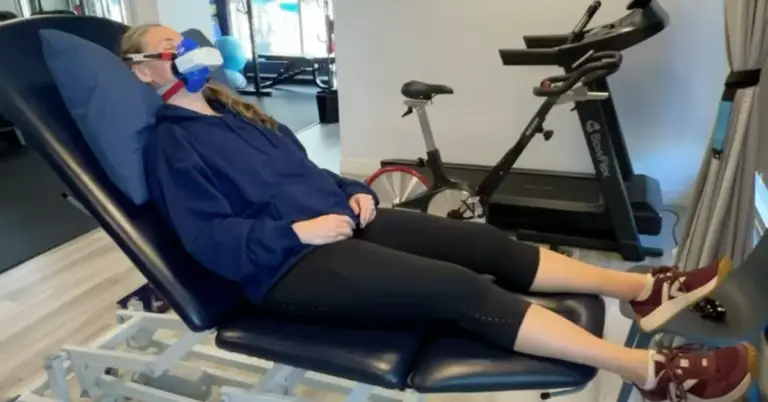
During VO₂ max testing and other physiological assessments, accurate heart rate measurement is more important because heart rate is being connected with physiological events such as ventilatory thresholds and maximum exercise intensity.
Heart rates recorded at ventilatory thresholds and maximal exercise may later be used to establish training zones. For that reason, I use a chest strap during physiological testing rather than relying solely on wrist PPG.
Can Inaccurate Heart Rate Affect Your Training Zones?
Depending on the device and your settings, running watches may use heart rate data to estimate or update maximum heart rate, heart rate zones, threshold values, training load, recovery metrics, and fitness estimates. Manufacturers use different algorithms, and many of those calculations include additional data beyond heart rate.
Repeatedly inaccurate readings can distort an input such as maximum heart rate. For example, cadence lock during hard running could produce an unusually high heart rate value. If the watch accepts that value as a new maximum and your zones are calculated as percentages of HRmax, the zone boundaries may shift as well.
This is one reason to check how your watch generated its heart rate zones before relying on them for specific training targets.
If you’re not sure where your maximum heart rate should come from, read [Maximum Heart Rate for Runners: Why 220 Minus Age Can Be Wrong].
How to Get Better Wrist Heart Rate Data
Before buying a chest strap, check that your watch is fitted and positioned well enough for the optical sensor to collect a stable signal.
- Wear it snugly enough that it doesn’t bounce or slide while running
- Position it slightly above the wrist bone rather than directly over the top of it
- Keep the optical sensor clean
- Allow time to warm up in cold weather, when blood flow near the skin may be reduced
- Compare heart rate with cadence if you suspect cadence lock
- Look for repeated patterns rather than reacting to one unusual spike
- Keep your watch software up to date
If your readings remain consistently questionable and accurate heart rate is important for how you train, consider investing in a chest strap.
Do Runners Need a Chest Strap?
Most runners don’t need to wear a chest strap for every run. Modern wrist heart rate monitors can provide useful data during steady running, and the convenience of having heart rate built into your watch is hard to beat.
A chest strap is worth considering for intervals, physiological testing, establishing maximum heart rate, troubleshooting questionable wrist readings, or training where heart rate is being used very specifically to control intensity.
For an easy run where heart rate is simply one piece of feedback, wrist data may be completely sufficient. When you need faster and more dependable heart rate tracking, a chest strap is the better tool.
Key Takeaways
- Chest straps detect the electrical activity associated with each heartbeat, while wrist monitors use optical PPG to estimate heart rate from changes in blood volume.
- Chest straps generally provide more dependable heart rate measurements during exercise.
- Modern wrist monitors can perform well during steady walking and running.
- Movement, watch fit, temperature, and rapid changes in intensity can reduce wrist PPG accuracy.
- Cadence lock can cause a running watch to report a heart rate that closely follows running cadence.
- Wrist heart rate is often adequate for easy and steady running.
- Chest straps are useful for intervals, physiological testing, questionable wrist readings, and training where accurate heart rate directly influences the session.
- Repeated inaccurate heart rate readings can affect some watch-generated estimates and training zones.
- Wearing your watch securely and slightly above the wrist bone can improve wrist heart rate measurement.
Are Your Heart Rate Zones Based on the Right Data?
Accurate heart rate monitoring gives you more dependable training data, while useful training zones depend on understanding your individual physiological response to exercise.
VO₂ max testing measures VO2 max, maximum heart rate, ventilatory thresholds, and your response as exercise intensity increases. Those results can then be used to establish individual heart rate and pace training zones.If you’re local to the Vancouver area, you can book in for a VO₂ Max Test in Port Moody.
You can also subscribe to my newsletter or follow me on Instagram for more evidence based tips for runners.
Frequently Asked Questions About Chest Strap vs Wrist Heart Rate Monitors for Running
Chest straps generally provide more dependable heart rate measurements during exercise because they detect the electrical activity associated with each heartbeat. Wrist optical monitors can also perform well during steady running, although movement, fit, temperature, and rapid changes in intensity can affect accuracy.
For many runners, yes. If your watch fits securely and consistently produces believable readings, wrist-based heart rate is often adequate for steady easy and moderate runs. Using heart rate alongside pace and perceived effort provides additional context.
Cadence lock occurs when rhythmic movement during running interferes with the optical heart rate signal and the watch reports a heart rate close to your running cadence. A secure watch fit and good sensor contact may reduce the likelihood of it occurring.
Sudden high readings can occur because of poor sensor contact, movement artefact, or cadence lock. Compare the heart rate reading with your perceived effort, pace, and cadence, and look for repeated patterns before making training decisions from one unusual number.
A chest strap is useful for interval training because it can follow rapid changes in heart rate more closely than a wrist-based monitor. This gives you better information during short work and recovery periods.
Wear your watch snugly above the wrist bone so the optical sensor maintains consistent contact with your skin. The watch should stay in place during running without feeling uncomfortably tight.
It can, depending on how your watch calculates its zones. If inaccurate readings affect an input such as maximum heart rate, percentage-based zones calculated from that value may also be inaccurate. Check how your device has established your zones before relying on them for specific training intensities.
References
Bretonneau, Q., Peruque-Gayou, E., Wolfs, E., & Bosquet, L. (2023). Parameters Influencing the Accuracy of a Wrist Photoplethysmography Heart-Rate Monitor (Polar Unite) During Exercise. International journal of sports physiology and performance, 18(4), 440–443. https://doi.org/10.1123/ijspp.2022-0288
Koerber, D., Khan, S., Shamsheri, T., Kirubarajan, A., & Mehta, S. (2023). Accuracy of Heart Rate Measurement with Wrist-Worn Wearable Devices in Various Skin Tones: a Systematic Review. Journal of racial and ethnic health disparities, 10(6), 2676–2684. https://doi.org/10.1007/s40615-022-01446-9
Machado, A., Ferreira, D. F., Ferreira, S., Almeida-Antunes, N., Carvalho, P., Melo, P., Rocha, N., & Rodrigues, M. A. (2025). A Systematic Review of Chest-Worn Sensors in Cardiac Assessment: Technologies, Advantages, and Limitations. Sensors (Basel, Switzerland), 25(19), 6049. https://doi.org/10.3390/s25196049
Navalta, J. W., Perez, O. R., Mejia, R., & Bunn, J. A. (2025). The Effect of Tattoos on Heart Rate Validity in the Polar Verity Sense Commercial Wearable Device. Sensors (Basel, Switzerland), 25(22), 6896. https://doi.org/10.3390/s25226896
Zhang, Y., Weaver, R. G., Armstrong, B., Burkart, S., Zhang, S., & Beets, M. W. (2020). Validity of Wrist-Worn photoplethysmography devices to measure heart rate: A systematic review and meta-analysis. Journal of sports sciences, 38(17), 2021–2034. https://doi.org/10.1080/02640414.2020.1767348